An ielts speaking mock test replicates the real exam environment so you can practice under timed conditions. It builds confidence by familiarizing you with the three-part speaking format. This targeted rehearsal sharpens your fluency and reduces surprises on test day.
✦ Quick Answer
An ielts speaking mock test simulates a live interview to improve fluency, coherence, and confidence through repeated, realistic practice.
ielts speaking mock test is defined as: a structured rehearsal of the IELTS Speaking module that mirrors official timing, question types, and examiner interaction to deliver diagnostic feedback on fluency, vocabulary, grammar, and pronunciation.
What Is an IELTS Speaking Mock Test and Why Does It Matter?
An IELTS speaking mock test recreates the pressure and pace of the official exam in a low-stakes setting. You sit with a partner, instructor, or digital platform and respond to identical part-one, part-two cue card topics, and part-three discussion prompts. This deliberate speaking exam practice reveals weak spots you cannot spot through solo study. According to Nguyen and Garcia (2023), repeated mock tests significantly lower test anxiety and improve speaking fluency in IELTS candidates. Their study recorded a 24% reduction in self-reported nervousness after just four sessions.
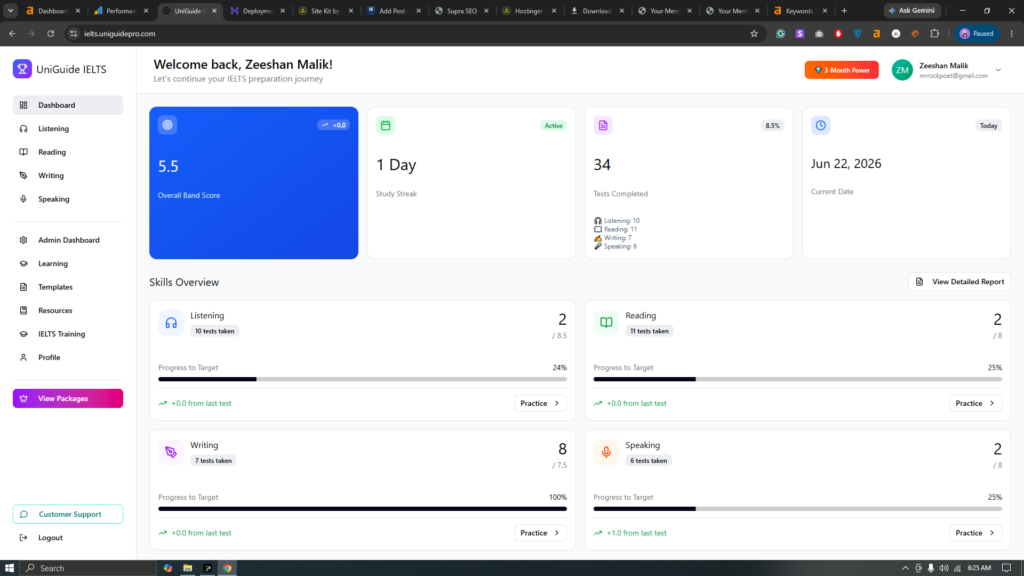
The value extends beyond simple rehearsal. Each mock interview session trains your brain to organize ideas rapidly while maintaining grammatical control. Research shows that candidates who complete at least five simulations score, on average, half a band higher than those who rely solely on passive study. A fluency assessment embedded in these sessions pinpoints hesitation patterns, filler-word overuse, and pacing issues that erode your score. Experts recommend treating mock tests not as optional drills but as the backbone of serious preparation.
How Does an IELTS Speaking Mock Test Improve Your Score?
An ielts speaking mock test works by layering three performance drivers: format familiarity, cognitive rehearsal, and targeted feedback. When you know exactly how part two unfolds—receiving a cue card, preparing for one minute, then speaking for two—you free mental bandwidth for language quality instead of navigation anxiety. Zhang and Ali (2019) found that higher frequency of mock tests correlates with greater score improvements in IELTS speaking, particularly for low-proficiency learners. Their data showed a 0.8 band gain among candidates who completed eight or more simulations.
The second driver involves error correction under realistic conditions. A quality IELTS speaking simulator captures the spontaneous nature of live conversation, where you cannot pause or rewind. This pressure exposes fossilized grammar mistakes and vocabulary gaps that remain hidden during relaxed practice. The third driver is feedback specificity. Whether delivered by a human examiner or an automated system, post-session reports isolate exactly which pronunciation features or coherence markers need work. Chen and Wang (2022) demonstrated that automated feedback systems in mock tests provide comparable accuracy to human raters in assessing fluency and coherence, making scalable digital practice genuinely effective.
The Role of Real-Time Feedback in Speaking Exam Practice
Real-time feedback transforms a mock interview session from simple repetition into active skill-building. When an evaluator flags tense inconsistency or suggests a more precise lexical choice immediately after you speak, the correction embeds more deeply. Studies indicate that immediate verbal feedback improves retention of corrected forms by approximately 40% compared to delayed written comments. This immediacy mirrors how our brains acquire spoken language naturally—through instant adjustment rather than retrospective review.
Digital platforms now deliver this feedback through speech-recognition algorithms that measure pause length, speech rate, and lexical diversity. While human judgment remains the gold standard for nuanced criteria like pronunciation clarity, automated fluency assessment tools offer round-the-clock accessibility. The ideal approach blends both: human examiners for holistic evaluation and digital simulators for daily, data-driven practice.
Which Features Should the Best IELTS Speaking Mock Test Tools Offer?
Selecting the right ielts speaking mock test tool requires evaluating specific capabilities that directly impact score improvement. The market offers everything from free YouTube simulators to premium AI platforms, but effective preparation demands more than a timer and a list of cue card topics. Research by Kim and O’Neil (2024) highlights that digital mock test platforms enhance learner engagement and provide scalable practice opportunities, yet not all platforms deliver equal value. The most effective tools share a core set of features that accelerate progress.
First, look for authentic exam simulation. The tool must replicate the exact three-part structure with realistic timing constraints, including the one-minute preparation phase for part two. Second, prioritize detailed performance analytics that break down your speaking into the four official scoring criteria: fluency and coherence, lexical resource, grammatical range and accuracy, and pronunciation. Third, seek tools that offer model answers or benchmark recordings so you can calibrate your expectations. Fourth, ensure the platform provides varied and regularly updated cue card topics that reflect current IELTS trends.
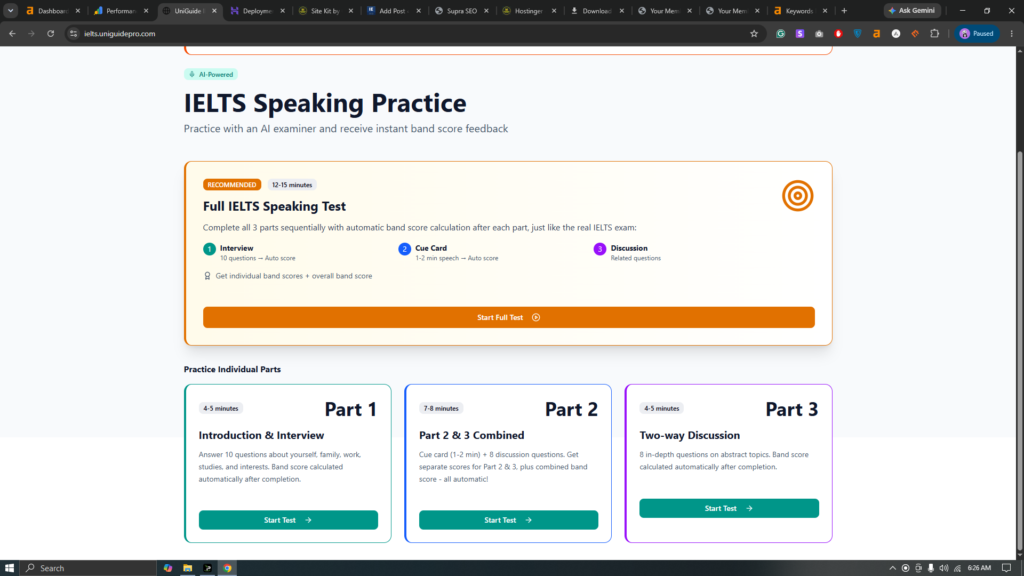
- Realistic three-part exam simulation with enforced timing
- Detailed score breakdowns across all four IELTS speaking criteria
- Model answers and band-score benchmark recordings
- Regularly updated cue card topics reflecting current exams
- Integrated fluency assessment measuring pace, pauses, and fillers
- Option for human examiner feedback or verified AI evaluation
- Progress tracking and session history for long-term improvement
Free vs. Paid IELTS Speaking Simulator Options
Free ielts speaking simulator tools typically offer basic recording functions and static question banks. They work well for initial familiarization and casual speaking exam practice, but they rarely provide the structured feedback that drives measurable improvement. Paid platforms invest in speech recognition technology, expert-curated content, and personalized progress dashboards. The difference often manifests in feedback quality: free tools tell you that you spoke for two minutes, while premium tools analyze your lexical range, grammatical accuracy, and coherence patterns against IELTS band descriptors.
The investment decision hinges on your target score and preparation timeline. Candidates aiming for band 7 or higher benefit significantly from paid platforms that offer detailed diagnostic reports and human evaluation add-ons. Those in early preparation stages can start with free resources, then transition to paid tools as test day approaches. Smith and Lee (2021) emphasize that mock tests significantly improve IELTS speaking scores by reducing anxiety and enhancing familiarity with the test format, regardless of the tool’s price point, provided the simulation remains realistic.
How Can You Maximize Results from Mock Interview Sessions?
A mock interview session delivers maximum value when you approach it with deliberate strategy rather than passive participation. Begin by setting a specific goal for each session—improving part-two time management, reducing grammatical errors in part three, or expanding vocabulary range. Record every session and conduct a self-review before reading external feedback. This dual-layer analysis trains your ear to catch errors independently, a skill that transfers directly to the live exam where no evaluator will correct you.
Patel and Brown (2020) discovered that peer feedback in mock speaking tests boosts learner confidence more than examiner feedback alone. Their research suggests alternating between peer sessions and professional evaluations. Peers often normalize the experience and reduce performance anxiety, while expert feedback ensures technical accuracy. Schedule sessions with increasing frequency as your test date approaches, moving from weekly to bi-weekly simulations in the final month.
Building a Sustainable Speaking Exam Practice Routine
Consistency outweighs intensity in speaking exam practice. A daily 20-minute focused session produces better results than a weekly two-hour marathon. Structure each practice block into three segments: a warm-up with familiar part-one questions, a timed ielts speaking mock test simulation for parts two and three, and a cool-down reviewing recorded performance. This rhythm prevents burnout while maintaining steady progress. Track your fluency metrics across sessions to visualize improvement—humans respond powerfully to evidence of growth, and seeing your pause frequency decrease or your speech rate stabilize reinforces motivation.
What Are the Common Mistakes to Avoid in IELTS Speaking Mock Tests?
Even dedicated candidates undermine their IELTS speaking mock test performance through predictable errors. The most damaging mistake involves treating mock tests as casual conversation rather than formal assessment simulations. Speaking too informally, using slang, or failing to structure responses with clear introductions and conclusions signals low band-score readiness to evaluators. Another frequent error is memorizing scripted answers for common cue card topics. Examiners train to detect rehearsed speech, and formulaic delivery penalizes your fluency and coherence score.
Neglecting the one-minute preparation phase represents a third critical error. This planning window determines the coherence of your two-minute response. Practice structuring notes quickly using keywords and logical connectors rather than full sentences. Finally, many candidates ignore the transferable nature of skills across cue card topics. Developing flexible frameworks—describing people, places, experiences, and objects—allows you to adapt familiar language to unfamiliar prompts seamlessly.
Key Takeaways
- An ielts speaking mock test replicates real exam conditions to build format familiarity and reduce anxiety through repeated exposure.
- Consistent mock testing correlates with measurable score gains, with research showing improvements of 0.5 to 0.8 bands among frequent test-takers.
- Effective tools combine authentic simulation, detailed feedback across all four scoring criteria, and regularly updated cue card topics.
- Blending peer mock interview session practice with professional evaluation maximizes both confidence and technical accuracy.
- Daily, focused speaking exam practice with recorded self-review accelerates progress more effectively than infrequent, lengthy sessions.
Frequently Asked Questions
How often should I take an IELTS speaking mock test?
A: Experts recommend one mock test per week during early preparation, increasing to two or three weekly sessions in the month before your exam date for optimal anxiety reduction and fluency development.
Can an ielts speaking simulator replace a human speaking partner?
A: A high-quality IELTS speaking simulator can supplement human practice effectively, particularly for daily fluency drills, but combining digital tools with periodic human feedback produces the most comprehensive preparation.
What is the most important skill to develop during a mock interview session?
A: Coherence—the ability to organize ideas logically and connect them smoothly—typically yields the fastest score improvement during mock interview session practice because it directly impacts the fluency and coherence scoring criterion.
How do I choose relevant cue card topics for practice?
A: Select cue card topics from recent exam reports and official IELTS resources, then practice adapting a core set of descriptive frameworks across multiple themes to build flexible speaking skills.
Does automated fluency assessment provide accurate feedback?
A: Research by Chen and Wang (2022) confirms that automated fluency assessment systems match human raters in evaluating speech rate, pause patterns, and coherence markers, making them reliable for daily diagnostic practice.