1. What Is the IELTS Reading Test?
The IELTS Reading test measures your ability to understand written English across a wide range of topics — from science and history to social issues and business. It is one of the four sections of the International English Language Testing System (IELTS), which is accepted by over 11,000 organisations worldwide including universities, employers, and immigration authorities.
There are two versions of the reading test: Academic (for university and professional registration) and General Training (for migration and work purposes). This guide focuses primarily on the Academic module, which is more challenging and more widely used for higher education applications.
💡 Key Fact
The IELTS Reading test does not have a minimum passing score. Your score is reported on the IELTS 9-band scale. Most universities require a band of 6.5–7.0 in reading.
2. Test Format Explained
Knowing the format before you practice is half the battle. The IELTS Academic Reading test has a fixed structure that never changes:
| Component | Details |
|---|---|
| Number of passages | 3 long reading passages |
| Total questions | 40 questions |
| Time allowed | 60 minutes (no extra transfer time) |
| Word count per test | Approximately 2,150–2,750 words total |
| Topics | Academic, non-specialist (science, history, social issues) |
| Marking | 1 mark per correct answer; no negative marking |
Each passage increases slightly in difficulty. Passage 1 is generally the most accessible, while Passage 3 requires deeper analytical reading. Time management is critical — most test-takers spend roughly 20 minutes per passage.
3. Question Types You Will Face
The IELTS reading test uses a variety of question formats within a single test. Understanding each type is essential for effective IELTS reading test practice.
Matching Headings
Match a list of headings to paragraphs or sections of the text.
True / False / Not Given
Decide if statements agree with, contradict, or are not addressed in the passage.
Yes / No / Not Given
Similar to T/F/NG but focuses on the writer’s opinions and claims.
Sentence Completion
Fill in the blanks using words taken directly from the passage.
Summary Completion
Complete a short paragraph summary using words from a box or the text.
Matching Information
Find specific information and match it to the correct paragraph.
Short Answer Questions
Answer questions in a set number of words taken from the text.
Diagram / Table Labelling
Label a diagram or complete a table using information from the passage.
On the UniGuidePro platform, each practice test includes a mix of these question types — exactly as they appear in the real exam — so you build genuine familiarity before test day.
4. How to Practice on UniGuidePro
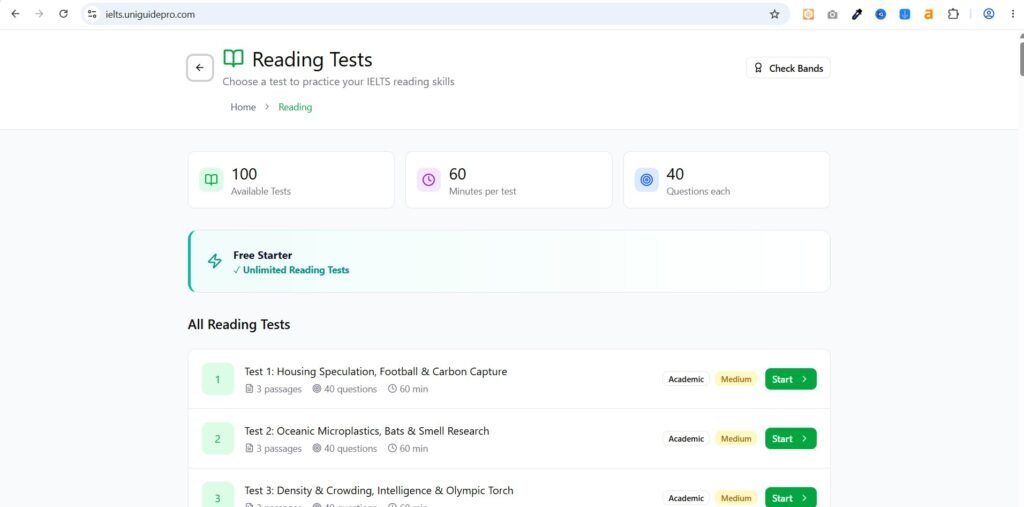
ielts.uniguidepro.com offers over 100 free IELTS reading practice tests with real exam conditions. Here is how to get started in under two minutes:
1
Go to the Reading Tests library
Visit ielts.uniguidepro.com and click Reading Tests from the main menu. You will see the full library of 100+ tests, each tagged with difficulty level and topic.
2
Choose a test and click Start
Every test shows the number of passages (3), questions (40), and time (60 min). Pick any test and click the green Start button to begin immediately — no login required for free tests.
3
Read the passage, answer questions
The split-screen layout shows the passage on the left and questions on the right, mirroring real test conditions. Scroll independently on each side.
4
Submit and get your instant band score
Click Submit Test when done. Your score, band estimate, and a full answer key appear instantly — including which answers were wrong and what the correct answers were.
5. Inside a Practice Test — Platform Screenshots
Here is a look at the actual UniGuidePro interface so you know exactly what to expect before you start practicing.
Once you click Start, the test opens in a clean split-screen view. The passage occupies the left panel and all questions appear on the right — exactly as in the paper-based IELTS exam. You can scroll each side independently.
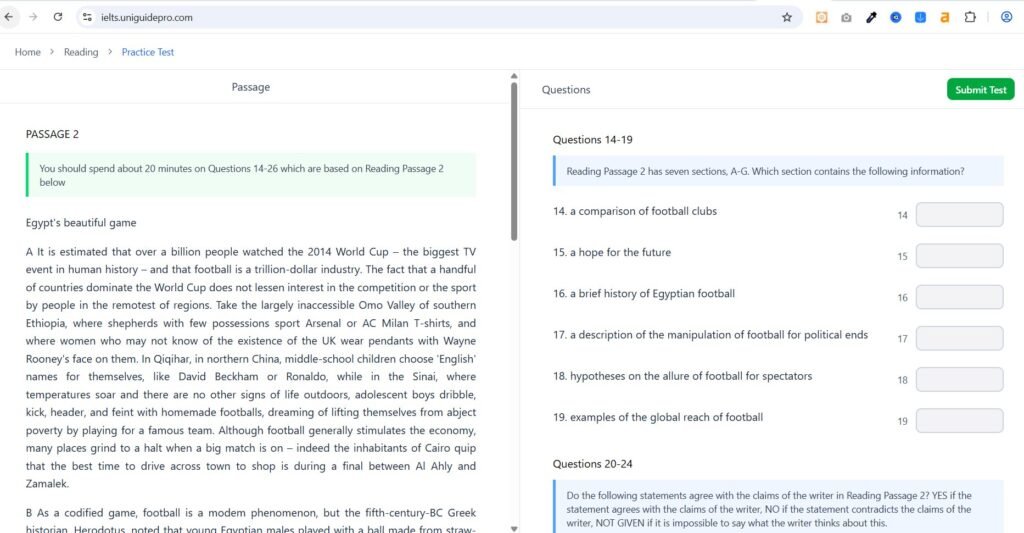
📋 What you see in the screenshot
This is Passage 2 from Test 1: Egypt’s Beautiful Game — a real IELTS-style academic passage about football culture. Questions 14–19 ask you to match information to sections A–G, and Questions 20–24 are True/False/Not Given based on the writer’s claims. This exact format appears in every real IELTS Academic reading exam.
6. Instant Band Score Checker
One of the most powerful features of UniGuidePro is the Instant Band Score Checker. The moment you submit a test, a results modal appears showing:
- Your raw score (e.g. 32 / 40 correct)
- Your estimated IELTS Band Score (0–9)
- A question-by-question breakdown: your answer, the correct answer, and pass/fail status
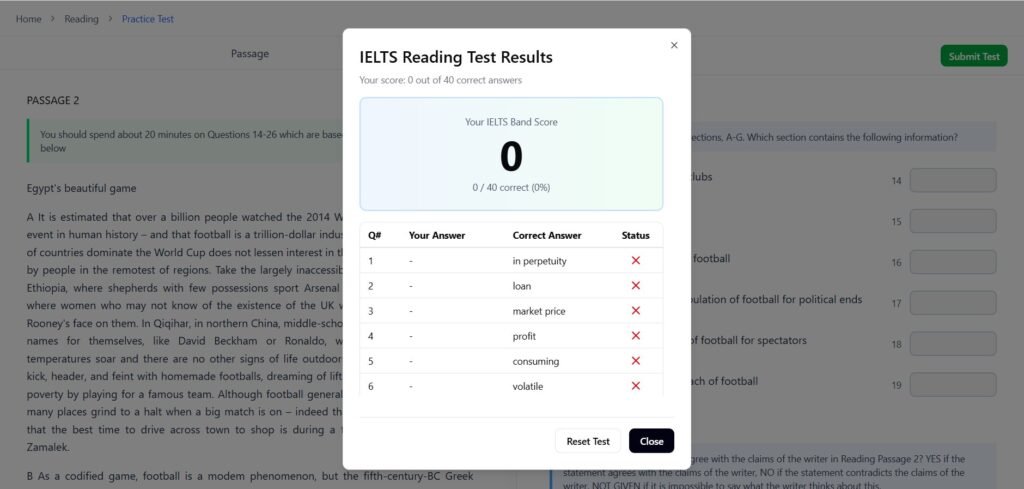
The score shown above is zero because this was a demonstration run with no answers filled in — designed to show you the full answer key at a glance. When you practice seriously and answer all 40 questions, your results will reflect your actual reading level. Use this feature to review every mistake and understand exactly what the correct answer was and why.
💡 Pro Tip: Use the Answer Key Strategically
After submitting, go back through each wrong answer and locate the evidence in the passage. This active review — called “error analysis” — is the single fastest way to improve your IELTS reading score. Aim to review your mistakes within five minutes of finishing a test while the passage is still fresh.
7. IELTS Reading Band Score Conversion Table
Your raw score (number of correct answers out of 40) is converted to an IELTS band using an official conversion scale. Use this table to set your target score.
| Correct Answers (out of 40) | IELTS Band Score | Level |
|---|---|---|
| 39–40 | 9.0 | Expert |
| 37–38 | 8.5 | Very Good |
| 35–36 | 8.0 | Very Good |
| 33–34 | 7.5 | Good |
| 30–32 | 7.0 | Good |
| 27–29 | 6.5 | Competent |
| 23–26 | 6.0 | Competent |
| 19–22 | 5.5 | Modest |
| 15–18 | 5.0 | Modest |
| 13–14 | 4.5 | Limited |
| 10–12 | 4.0 | Limited |
| 0–9 | Below 4.0 | Extremely Limited |
Most universities require Band 6.5–7.0 in reading, which means getting at least 27–34 correct answers. Set your daily practice goal around this threshold and use UniGuidePro’s band checker to track your progress across multiple tests.
8. Top Strategies to Score Higher in IELTS Reading
Skim First, Then Read
Never start answering from line one. Spend the first 2–3 minutes skimming each passage for the overall structure, subheadings (if any), and the first and last sentence of each paragraph. This mental map saves you time when locating specific answers.
Read Questions Before the Passage
Before reading a passage in detail, scan the questions. Underline keywords in each question — names, dates, unusual words. As you read, you will recognise these keywords instantly and know where to focus.
True / False / Not Given: Stay in the Text
The most common mistake in T/F/NG questions is answering from general knowledge. Every answer must come directly from what the passage says. If the text does not address a statement at all, the answer is Not Given — even if you know the real-world answer to be true.
Never Leave a Blank
There is no negative marking in IELTS. If you are unsure, make an educated guess. A blank is guaranteed zero; a guess gives you a chance. Use the last two minutes to fill in any unanswered questions.
Practice Under Real Time Pressure
UniGuidePro’s timed tests are ideal for this. Set a 60-minute timer and do not pause. Practicing under genuine time pressure is the best simulation of real exam conditions and helps you build the pacing instincts that matter on test day.
Review Every Wrong Answer
Use the instant answer key to find every wrong answer, then go back to the passage and identify exactly where the correct answer was located. Understanding why you were wrong is more valuable than simply retaking a test.
🎯 Recommended Practice Schedule
Take one full 60-minute practice test every 2–3 days. On the days in between, focus on reviewing your mistakes and practising specific question types (e.g. 10 True/False/Not Given questions in 15 minutes). Consistent spaced practice outperforms cramming significantly for IELTS reading.