If you are searching for an IELTS Reading test with answers PDF, you are in the right place. This article gives you a complete overview of the IELTS Reading section, explains every question type, and provides practice test material you can use directly — with answers included.
Whether you are preparing for IELTS Academic or IELTS General Training, this guide will help you understand exactly what to expect and how to score higher on test day.
What Is the IELTS Reading Test?
The IELTS Reading test is one of the four sections of the IELTS exam. It lasts exactly 60 minutes and contains 40 questions based on three reading passages.
IELTS Academic Reading: The three passages are taken from books, journals, magazines, and newspapers. They are written for a non-specialist audience but deal with complex academic topics. At least one passage contains a detailed argument.
IELTS General Training Reading: The passages include notices, advertisements, workplace documents, and longer descriptive texts. The language is more everyday but the questions still require careful reading.
Both versions are marked out of 40, and raw scores are converted to a band score between 1 and 9.

IELTS Reading Band Score Chart
Understanding how your raw score converts to a band score helps you set a realistic target:
| Raw Score (out of 40) | Academic Band | General Band |
|---|---|---|
| 39–40 | 9.0 | 9.0 |
| 37–38 | 8.5 | 9.0 |
| 35–36 | 8.0 | 8.5 |
| 33–34 | 7.5 | 8.0 |
| 30–32 | 7.0 | 7.5 |
| 27–29 | 6.5 | 7.0 |
| 23–26 | 6.0 | 6.5 |
| 19–22 | 5.5 | 6.0 |
| 15–18 | 5.0 | 5.5 |
Tip: For most UK universities, you need a minimum of Band 6.5 in Reading. Canadian immigration (Express Entry) typically requires Band 6.0 or above.
IELTS Reading Question Types — Complete Guide
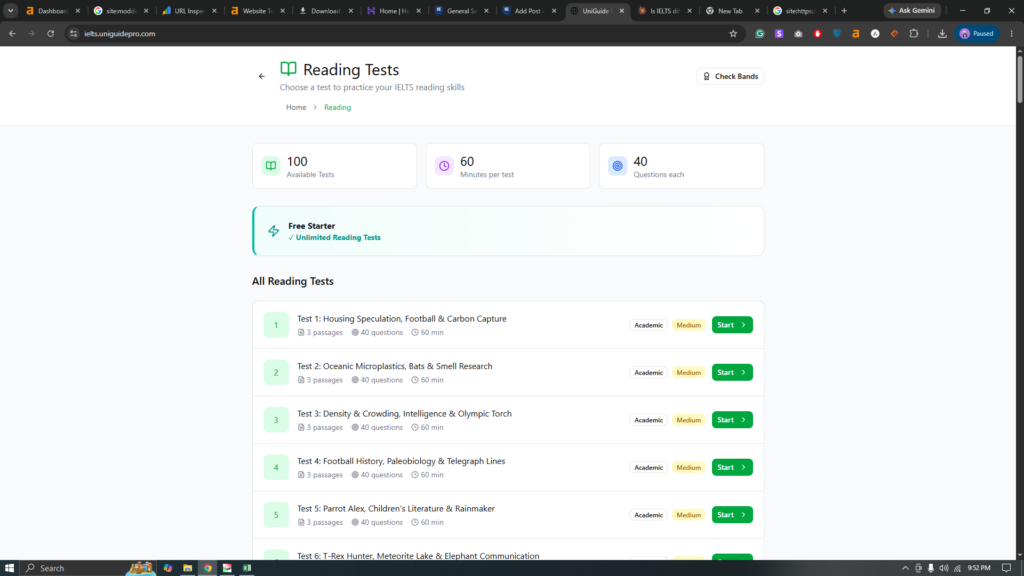
There are 11 question types in the IELTS Reading test. You must know all of them to avoid losing easy marks.
1. True / False / Not Given
This is the most misunderstood question type. Students often confuse False with Not Given.
- True — The statement agrees with the information in the passage
- False — The statement contradicts the information in the passage
- Not Given — The information is not mentioned anywhere in the passage
The key rule: If you cannot find evidence either way, the answer is Not Given — not False.
2. Yes / No / Not Given
This type appears with opinion-based passages. Instead of facts, you are asked whether the statement agrees with the writer’s opinion.
- Yes — The statement agrees with the writer’s views
- No — The statement contradicts the writer’s views
- Not Given — The writer’s opinion on this point is not given
3. Matching Headings
You are given a list of headings and must match each one to the correct paragraph. There are always more headings than paragraphs.
Strategy: Read the first and last sentence of each paragraph first. The heading should capture the main idea, not a supporting detail.
4. Multiple Choice Questions (MCQ)
You choose the correct answer from four options (A, B, C, D), or sometimes select two or three answers from a longer list.
Strategy: Read the question carefully before scanning the passage. The options are designed to confuse — look for paraphrase, not exact matching words.
5. Matching Information
You must find which paragraph contains specific information — a fact, reason, description, comparison, or explanation.
Strategy: Underline the key noun in each statement, then scan paragraphs quickly. Paragraphs can be used more than once.
6. Matching Features
You match a list of statements to a set of options (usually names of people, places, dates, or theories). This tests your ability to identify specific details.
7. Matching Sentence Endings
You are given the first half of a sentence and must choose the correct ending from a list. Answers follow the order of the passage.
8. Sentence Completion
You fill in the gap in a sentence using words directly from the passage. Always check the word limit — answers are usually 1, 2, or 3 words.
Critical rule: Never change the form of the word. Use it exactly as it appears in the passage.
9. Summary / Note / Table / Flow Chart Completion
You complete a summary, table, or diagram using words from the passage or from a given word list. This tests your overall understanding of a section of the text.
10. Short Answer Questions
You answer questions in your own words but using language directly from the passage. Word limits are strict — usually no more than three words.
11. Diagram Label Completion
You label parts of a diagram, map, or process using words from the passage. These appear more often in General Training.
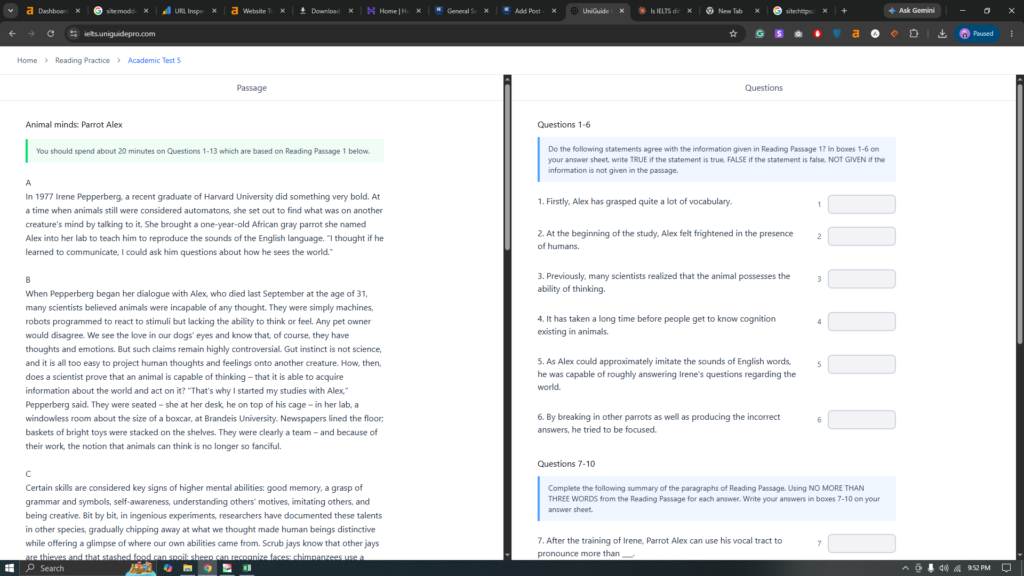
IELTS Academic Reading — Practice Test 1 with Answers
Passage 1: The Science of Sleep
Read the following passage and answer Questions 1–13.
Sleep is not simply a state of rest. Scientists now understand that sleep is an active biological process during which the brain consolidates memories, repairs cells, and regulates hormones. Despite occupying roughly one-third of human life, sleep remains one of the least understood physiological phenomena.
The two main types of sleep are REM (Rapid Eye Movement) sleep and non-REM sleep. Non-REM sleep is divided into three stages, progressing from light sleep to deep sleep. Deep sleep, also known as slow-wave sleep, is the most physically restorative phase. REM sleep, on the other hand, is associated with vivid dreaming and plays a critical role in emotional processing and memory consolidation.
Circadian rhythms — the internal biological clock — regulate the sleep-wake cycle over a roughly 24-hour period. These rhythms are primarily influenced by light exposure. When light enters the eye, it signals the brain to suppress melatonin, a hormone that promotes sleep. In the evening, as light decreases, melatonin levels rise, preparing the body for sleep.
Sleep deprivation has been linked to a range of serious health consequences. Studies show that adults who consistently sleep fewer than six hours per night face a significantly higher risk of cardiovascular disease, obesity, and type 2 diabetes. Additionally, even one night of poor sleep can impair cognitive function to a degree comparable to legal alcohol intoxication.
Researchers have also identified a protein called adenosine that accumulates in the brain during waking hours and creates what is commonly called sleep pressure. Caffeine works by blocking adenosine receptors, which temporarily suppresses the feeling of tiredness — but does not reduce the underlying adenosine buildup.
Questions 1–6: True / False / Not Given
Do the following statements agree with the information in the passage?
Write TRUE, FALSE, or NOT GIVEN for each statement.
- Sleep is a passive process during which the body simply rests.
- REM sleep occurs before non-REM sleep in a typical sleep cycle.
- Deep sleep is the most physically restorative stage of sleep.
- Melatonin is suppressed when light enters the eye.
- Adults who sleep fewer than six hours always develop diabetes.
- Caffeine removes adenosine from the brain completely.
Questions 7–10: Sentence Completion
Complete the sentences below. Use NO MORE THAN TWO WORDS from the passage.
- The internal biological clock is known as __________.
- Melatonin is a hormone that __________ sleep.
- The accumulation of adenosine in the brain creates __________.
- Caffeine works by blocking __________ in the brain.
Questions 11–13: Multiple Choice
Choose the correct letter, A, B, C, or D.
11. What is the main function of REM sleep?
A. Physical repair of cells and tissues
B. Regulation of body temperature
C. Emotional processing and memory consolidation
D. Production of melatonin
12. What does the passage say about one night of poor sleep?
A. It permanently damages cognitive function
B. It impairs thinking to a degree similar to alcohol intoxication
C. It reduces melatonin for up to 48 hours
D. It has no significant effect on healthy adults
13. According to the passage, circadian rhythms are primarily influenced by:
A. Diet and exercise habits
B. Room temperature at night
C. Light exposure
D. Adenosine levels in the brain
✅ Answer Key — Passage 1: The Science of Sleep
True / False / Not Given:
| Q | Answer | Reason |
|---|---|---|
| 1 | FALSE | “Deep sleep… is the most physically restorative phase.” |
| 2 | NOT GIVEN | The order of sleep cycles is not described in the passage |
| 3 | TRUE | “light… signals the brain to suppress melatonin.” |
| 4 | TRUE | The passage says “significantly higher risk” — not “always develop.” |
| 5 | FALSE | The passage says “significantly higher risk” — not “always develop” |
| 6 | FALSE | Caffeine blocks receptors but “does not reduce the underlying adenosine buildup” |
Sentence Completion:
| Q | Answer |
|---|---|
| 7 | circadian rhythms |
| 8 | promotes |
| 9 | sleep pressure |
| 10 | adenosine receptors |
Multiple Choice:
| Q | Answer |
|---|---|
| 11 | C |
| 12 | B |
| 13 | C |
IELTS Academic Reading — Practice Test 2 with Answers
Passage 2: Urban Farming and Food Security
Read the following passage and answer Questions 14–26.
Urban farming — the practice of cultivating food within city limits — has emerged as a significant response to growing concerns about food security, environmental sustainability, and urban poverty. From rooftop gardens in New York to vertical farms in Singapore, cities around the world are increasingly integrating agricultural production into their built environments.
Proponents of urban farming argue that it reduces the distance food travels from farm to plate, thereby cutting carbon emissions associated with transportation. A study published in the journal Environmental Science and Technology found that locally grown vegetables can have a carbon footprint up to 50% lower than those transported over long distances. Furthermore, urban farms tend to use water more efficiently through drip irrigation and hydroponic systems.
Critics, however, point out significant limitations. Urban land is expensive, and the energy costs associated with indoor vertical farming — particularly artificial lighting — can exceed the environmental savings made through reduced transportation. A 2021 analysis found that certain vertical farms consumed up to eight times more electricity per kilogram of produce than conventional greenhouse farming.
Despite these concerns, urban farming has shown particular promise in addressing food deserts — areas within cities where residents have limited access to affordable, nutritious food. Community gardens and urban farms in such areas have been shown to improve dietary habits, reduce reliance on processed food, and provide residents with a source of income and community engagement.
The future of urban farming may depend heavily on technological advancement. Innovations such as AI-driven crop monitoring, LED lighting optimised for plant growth, and closed-loop water systems are already making urban farms more efficient. Researchers at several leading universities believe that within two decades, urban farms could supply up to 30% of a city’s fresh vegetable needs.
Questions 14–18: Matching Headings
The passage has five paragraphs (A–E). Match each paragraph with the correct heading from the list below.
List of Headings:
i. The role of technology in making urban farming viable
ii. Environmental advantages claimed by urban farming supporters
iii. Why urban farming is growing worldwide
iv. Energy costs that undermine environmental claims
v. How urban farms help food-insecure communities
vi. Government policies supporting urban agriculture
| Paragraph | Heading Number |
|---|---|
| A | ? |
| B | ? |
| C | ? |
| D | ? |
| E | ? |
Questions 19–22: Yes / No / Not Given
Do the following statements agree with the views of the writer?
- Urban farming is a worthwhile response to food security concerns.
- Vertical farming is always more environmentally friendly than conventional farming.
- Community gardens can improve the lives of residents in food deserts.
- Urban farms will completely replace rural agriculture within two decades.
Questions 23–26: Short Answer Questions
Answer using NO MORE THAN THREE WORDS from the passage.
- What type of irrigation do urban farms use to save water?
- What term describes city areas with poor access to affordable food?
- What technology is being used to monitor crops in modern urban farms?
- According to researchers, what percentage of a city’s fresh vegetables could urban farms supply within 20 years?
✅ Answer Key — Passage 2: Urban Farming and Food Security
Matching Headings:
| Paragraph | Answer |
|---|---|
| A | iii |
| B | ii |
| C | iv |
| D | v |
| E | i |
Yes / No / Not Given:
| Q | Answer | Reason |
|---|---|---|
| 19 | YES | Writer calls it “a significant response” to food security concerns |
| 20 | NO | The passage contradicts this with data on energy consumption |
| 21 | YES | “shown to improve dietary habits… and provide residents with a source of income” |
| 22 | NOT GIVEN | The passage says “up to 30% of fresh vegetables” — complete replacement is not discussed |
Short Answer Questions:
| Q | Answer |
|---|---|
| 23 | drip irrigation |
| 24 | food deserts |
| 25 | AI-driven crop monitoring |
| 26 | 30% (up to 30 percent) |
IELTS General Training Reading — Practice Test with Answers
Section 1: Workplace Notice
Read the following notice and answer Questions 27–32.
CITY CENTRE LIBRARY — READER INFORMATION
Opening hours: Monday to Friday 9:00 AM – 8:00 PM | Saturday 10:00 AM – 5:00 PM | Sunday Closed
Membership: All residents of the city may register for a free library card. Proof of address (a utility bill or bank statement dated within the last three months) is required at registration. Cards are valid for two years and must be renewed in person.
Borrowing: Standard members may borrow up to 8 items at a time, including a maximum of 4 DVDs. Items may be kept for 21 days and renewed once online or by telephone. Overdue items incur a fine of 10p per day per item. Lost items must be replaced or paid for at current purchase price.
Computer Access: Free internet access is available at all library terminals. Sessions are limited to 30 minutes when other users are waiting. Printing is available at 10p per black-and-white page and 25p per colour page.
Children’s Section: Children under 14 must be accompanied by an adult at all times. The children’s reading group meets every Saturday at 11:00 AM.
Questions 27–32: True / False / Not Given
- Library membership is free for all city residents.
- A driving licence is acceptable as proof of address.
- Members can borrow up to four DVDs at one time.
- Items can be renewed twice online.
- Internet sessions have a time limit at busy times.
- The children’s reading group meets on Sundays.
✅ Answer Key — General Training Section 1
| Q | Answer | Reason |
|---|---|---|
| 27 | TRUE | “All residents of the city may register for a free library card” |
| 28 | NOT GIVEN | Only utility bill or bank statement is mentioned — driving licence not discussed |
| 29 | TRUE | “maximum of 4 DVDs” |
| 30 | FALSE | “renewed once online or by telephone” — only one renewal allowed |
| 31 | TRUE | “Sessions are limited to 30 minutes when other users are waiting” |
| 32 | FALSE | The reading group meets on Saturday at 11:00 AM, not Sunday |
Top 10 IELTS Reading Tips to Score Band 7+
- Do not read the passage first — read the questions first, then scan for answers
- Answers follow the order of the passage — for most question types except Matching Headings
- Never leave a blank — there is no negative marking, so always guess
- Watch the word limit strictly — “no more than two words” means exactly that
- Paraphrase is everywhere — the question will not use the same words as the passage
- Not Given ≠ False — if you cannot find it, it is Not Given
- Skim headings and topic sentences first — they tell you what each paragraph is about
- Underline keywords in questions — it speeds up scanning significantly
- Manage your time — spend no more than 20 minutes per passage
- Practice under timed conditions — speed is as important as accuracy
Common Mistakes in IELTS Reading (And How to Fix Them)
Mistake 1: Spending too long on one question Fix: Move on and come back. Never let one question cost you three.
Mistake 2: Writing more than the word limit Fix: Count your words before writing. Extra words make the whole answer wrong.
Mistake 3: Changing the word form Fix: Copy words exactly from the passage. “Cultivate” is not the same as “cultivation.”
Mistake 4: Confusing False and Not Given Fix: Ask yourself — “Does the passage say the opposite?” If yes, it is False. If the topic is simply not there, it is Not Given.
Mistake 5: Skipping the instructions Fix: Always re-read the instruction for each section. Word limits and answer formats change.
Frequently Asked Questions (FAQ)
Where can I download IELTS Reading tests with answers in PDF?
You can find free IELTS Reading practice tests with answer keys on this website. All tests follow the official Cambridge IELTS format, including Academic and General Training versions.
How many passages are in the IELTS Reading test?
There are three passages and 40 questions in total. Each passage has approximately 13–14 questions. The passages become progressively more difficult.
Is IELTS Reading the same for Academic and General Training?
No. Academic Reading uses complex passages from academic publications. General Training Reading includes shorter everyday texts such as notices, advertisements, and workplace documents.
How much time do I have for the IELTS Reading test?
You have exactly 60 minutes. Unlike the Listening test, there is no extra time to transfer answers — you write directly on the answer sheet.
What is a good score in IELTS Reading?
A Band 7.0 requires approximately 30 correct answers out of 40 in Academic. In General Training, Band 7.0 requires around 34 correct answers.
Can I practice IELTS Reading on my phone or tablet?
Yes. This website is fully mobile-friendly and all practice tests can be taken on any device.
Final Word
The IELTS Reading test rewards students who practice with purpose. Simply reading passages is not enough — you must practice every question type, learn to identify paraphrase, and develop strict time management habits.
Use the practice tests on this page regularly, check your answers honestly, and focus extra time on your weakest question types. With consistent effort, scoring Band 7 or above in Reading is absolutely within your reach.