Master all four skills — Listening, Reading, Writing & Speaking — with proven strategies, a structured 8-week study plan, and expert tips.
📅 Updated June 2025⏱ 18 min read🎯 Band 6.5 → 8.0✅ Academic & General Training
📋 Table of Contents IELTS Preparation
- What is IELTS? Test Format & Structure
- Understanding IELTS Band Scores
- IELTS Listening — Strategies & Tips
- IELTS Reading — Speed & Accuracy Techniques
- IELTS Writing — Task 1 & Task 2 Mastery
- IELTS Speaking — Fluency & Confidence
- 8-Week IELTS Study Plan
- Best IELTS Resources & Practice Materials
- Frequently Asked Questions
The International English Language Testing System (IELTS) is the world’s most widely recognised English proficiency test, accepted by over 11,000 organisations in 140+ countries — including universities, immigration authorities, and professional licensing bodies.
Whether you are targeting a top UK university, applying for a Canadian PR visa, or seeking registration with a medical council, a strong IELTS band score can open every door. Yet many test-takers underperform simply because they lack a structured preparation strategy — not because they lack English ability.
This guide gives you exactly that: a clear, actionable roadmap built on the same principles used by candidates who consistently achieve Band 7 and above.
Key fact: IELTS is taken by over 3.5 million people per year. With the right preparation strategy, most candidates can improve their band score by 0.5–1.5 bands within 8–12 weeks of focused study.
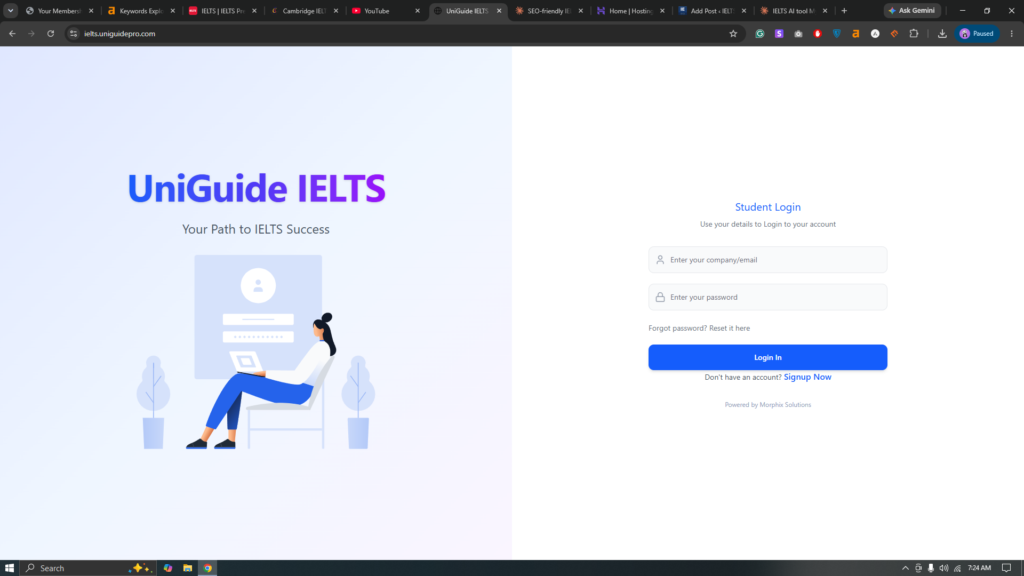
Prepare Free ielts on Uniguidepro
Section 1
What is IELTS? Test Format & Structure
IELTS tests four core English skills in a fixed format. It is jointly managed by the British Council, IDP: IELTS Australia, and Cambridge Assessment English. The test takes 2 hours 45 minutes in total.
🎧
Listening
40 min · 4 sections · 40 questions
📖
Reading
60 min · 3 passages · 40 questions
✍️
Writing
60 min · Task 1 + Task 2
🗣️
Speaking
11–14 min · 3-part interview
Academic vs General Training — What’s the Difference?
| Feature | Academic | General Training |
|---|---|---|
| Purpose | University admission, professional registration | Skilled migration, work visa, secondary education |
| Reading | Complex, academic-style passages | Everyday texts + one longer passage |
| Writing Task 1 | Describe a graph, chart, map, or process | Write a formal or informal letter |
| Writing Task 2 | Discursive essay — identical for both versions | |
| Listening | Identical for both versions | |
| Speaking | Identical for both versions | |
💡 Tip: Always confirm which version your university or visa authority requires before booking your test. Choosing the wrong version means sitting the test again.
Section 2
Understanding IELTS Band Scores
IELTS scores range from Band 1 (non-user) to Band 9 (expert user). Your overall band score is the average of the four component scores, rounded to the nearest 0.5.
| Band | Level | Typical Use Case | Common Requirements |
|---|---|---|---|
| 9 | Expert User | Elite academic roles | Some postgrad scholarships |
| 8 | Very Good User | Top UK/AUS universities | Medical / legal registration |
| 7 | Good User | Most universities | UK / Canada skilled visa |
| 6 | Competent User | Many colleges | Some PR pathways |
| 5 | Modest User | Foundation courses | Minimum thresholds |
💡 Tip: Many institutions set component minimums (e.g., no band below 6.0 in any skill) in addition to an overall requirement. Always check the exact criteria.
Section 3
IELTS Listening: Strategies to Maximise Your Score
The Listening test uses recordings of native Englielts.uniguidepro.comish speakers in four progressively challenging sections — from a casual social conversation to a complex academic monologue. Each section is heard only once, making active listening and anticipation skills essential.
Top Listening Strategies
- Preview questions before each section starts. Use the 30–45 seconds of reading time to identify keywords, question type, and likely answer format.
- Listen for paraphrasing. The audio almost never uses the exact words from the question — train yourself to recognise synonyms and rephrased ideas.
- Be careful with numbers and spellings. These are tested frequently and losing marks here is avoidable with focused practice.
- Use the 10-minute transfer time wisely. Check grammar, spelling, and that you have not exceeded word limits.
- Practise with authentic accents. IELTS features British, Australian, American, and Canadian accents. Use BBC Radio, TED Talks, and Australian news broadcasts.
- Predict answers. If the question says “the meeting is on ___”, you know a day, date, or time is coming — keep your pencil ready.
Common Question Types & How to Approach Them
| Type | Strategy |
|---|---|
| Multiple Choice | Read all options before the recording. Eliminate clearly wrong answers as you listen. |
| Form / Note Completion | Look at the form structure — answers usually follow the same sequence as the audio. |
| Map / Plan Labelling | Orient yourself first: find a fixed landmark (entrance, river) before the audio begins. |
| Sentence Completion | Predict the part of speech needed (noun, number, adjective) and write it immediately. |
| Matching | Read all options first; a speaker may mention several before confirming the correct one. |
💡 Expert tip: Aim for at least 30 correct answers out of 40 to achieve Band 7.0 in Listening. Practise full tests under timed conditions at least twice a week.
Section 4
IELTS Reading: Speed, Accuracy & Question Techniques
The Reading test is 60 minutes long with 40 questions across three passages. There is no extra transfer time — every answer goes directly onto the answer sheet. Time management is the single biggest challenge most candidates face.
Time Management Formula
Allocate time by difficulty: Passage 1 → 15 min | Passage 2 → 20 min | Passage 3 → 20 min | Transfer & check → 5 min. If you are stuck on a question, move on — every question is worth 1 mark.
Skimming vs. Scanning vs. Detailed Reading
- Skimming — Read the first sentence of each paragraph to grasp the overall structure (30 seconds per passage).
- Scanning — Search rapidly for specific information such as names, dates, statistics, or capitalised words.
- Detailed reading — Reserve this for the specific paragraph that contains the answer, not the whole text.
Question-Type Strategies
| Question Type | Key Strategy | Common Trap |
|---|---|---|
| True / False / Not Given | Match the writer’s exact claim, not general knowledge | Confusing “False” with “Not Given” — if it is not mentioned, it is NG |
| Matching Headings | Skim each paragraph for its ONE main idea before matching | Matching a detail, not the main idea |
| Summary Completion | Predict part of speech; answers are usually paraphrased | Choosing words not in the text or exceeding word limit |
| Multiple Choice | Locate the relevant paragraph first, then check each option | Being misled by partially correct options |
| Matching Information | Scan for proper nouns, statistics, and specific examples | Reading every paragraph linearly — waste of time |
💡 Tip: Build your vocabulary every day — IELTS Reading rewards candidates who can recognise paraphrased language. Use the Academic Word List (AWL) as your core vocabulary resource.
Section 5
IELTS Writing: Task 1 & Task 2 Mastery
Writing is where most candidates lose the most marks — and where targeted practice gives the greatest gains. The two tasks are assessed on four equally weighted criteria.
The Four Marking Criteria (Each Worth 25%)
🎯
Task Achievement / Response
Did you answer ALL parts of the question fully and directly?
🔗
Coherence & Cohesion
Are ideas logically organised with effective linking words?
📚
Lexical Resource
Do you use a wide, accurate, and natural range of vocabulary?
⚙️
Grammatical Range & Accuracy
Do you use a variety of sentence structures correctly?
Task 1 (Academic) — Describing Visual Data
You must write at least 150 words in about 20 minutes describing a graph, chart, table, map, or process diagram. The examiner wants to see accurate data selection, clear comparisons, and a strong overview — not your opinion.
- Always include an overview paragraph — this is the single most important element of Task 1.
- Describe the most significant trends, comparisons, and extremes — do not try to mention every number.
- Use data selectively and accurately — approximate where appropriate (“approximately 40%”).
- Do not include personal opinions or speculate about causes.
Task 1 (General Training) — Letter Writing
Write a letter of at least 150 words. Identify whether the tone should be formal (e.g., to a manager), semi-formal (e.g., to a neighbour), or informal (e.g., to a friend) — and maintain that tone throughout. Formal letters should never use contractions.
Task 2 — Essay Writing (Both Versions)
Task 2 carries twice the marks of Task 1. Write at least 250 words in about 40 minutes. Use this proven structure:
| Paragraph | Content | Approximate Length |
|---|---|---|
| Introduction | Paraphrase the question + state your position (thesis) | 40–60 words |
| Body Paragraph 1 | Topic sentence → explanation → example → link | 80–100 words |
| Body Paragraph 2 | Topic sentence → explanation → example → link | 80–100 words |
| Conclusion | Restate position + summarise key points (no new ideas) | 30–50 words |
💡 Tip: Examiners read thousands of essays. Stand out by using topic-specific vocabulary, avoiding clichés like “In today’s fast-paced world”, and showing a genuine opinion with well-reasoned support.
Section 6
IELTS Speaking: Fluency, Confidence & Natural English
The Speaking test is a face-to-face interview with a certified IELTS examiner, lasting 11–14 minutes. Unlike the other three tests, it is often conducted on a different day. It is divided into three distinct parts:
| Part | Format | Duration | What’s Tested |
|---|---|---|---|
| Part 1 | Examiner asks about familiar topics (home, work, hobbies, daily life) | 4–5 min | Ability to give extended answers on everyday topics |
| Part 2 | Individual long turn: speak for 1–2 min on a cue card topic | 3–4 min | Ability to organise and sustain a monologue |
| Part 3 | Two-way discussion: abstract, societal questions linked to Part 2 topic | 4–5 min | Ability to discuss complex ideas, give opinions, speculate |
Strategies for a High Speaking Band
- Avoid memorised scripts. Examiners are trained to detect them and will change the topic or penalise Lexical Resource marks.
- Use the PEEL structure for Part 3: Point → Explain → Example → Link back to the question.
- Self-correct naturally. Saying “…actually, I mean…” shows language awareness and is rewarded, not penalised.
- Record yourself daily. 5 minutes of daily speaking practice, recorded and reviewed, produces faster improvement than any other method.
- Use a range of tenses. Describing past experiences, current views, and hypothetical futures demonstrates grammatical range.
- Extend answers, especially in Part 1. Never give a one-word answer — always add a reason or example.
💡 Part 2 Hack: In the 1-minute preparation time, note ONE specific example for each bullet point on the cue card. Specific examples sound natural and prevent you from running out of things to say.
Section 7
8-Week IELTS Study Plan
This plan assumes 2–3 hours of study per day. Adjust the duration based on your starting level — if you are at Band 5.0 targeting Band 7.0, allow 12–16 weeks instead.
Weeks 1–2
🔍 Diagnostic & Foundations
Take a full mock test. Identify weakest skills. Study test format thoroughly. Begin vocabulary building (Academic Word List).
Week 3
🎧 Listening Focus
One full listening test per day. Analyse every wrong answer. Practise map labelling and form completion specifically.
Week 4
📖 Reading Focus
One timed passage per day. Practise T/F/NG and matching headings. Build speed with 15-minute passage challenges.
Week 5
✍️ Writing Task 1
Write one Task 1 per day. Compare with Band 8 model answers. Focus on overview paragraphs and data language.
Week 6
✍️ Writing Task 2
Write one essay every two days. Seek feedback from a tutor or online community. Learn 20+ high-band linking phrases.
Week 7
🗣️ Speaking Intensive
Daily 10-minute recorded speaking sessions. Practise 30+ cue card topics. Focus on fluency and pronunciation.
Week 8
📋 Full Mock Tests
One complete timed test every 2 days. Replicate exact test conditions. Review weaknesses. Rest 48 hours before the real test.
Test Day
🏆 Exam Day Strategy
Good sleep. Arrive early. Wear a watch. Do NOT discuss questions with others between Listening and Reading.
Section 8
Best IELTS Resources & Practice Materials
- 📘 BOOKCambridge IELTS Series (Books 1–18) — The gold standard for authentic practice. Published by Cambridge University Press in partnership with the exam board. Includes four complete tests per book with answer keys and audio.
- 🌐 FREEIELTS Liz (ieltsliz.com) — One of the most comprehensive free websites for tips, model answers, and video lessons across all four skills.
- 🌐 FREEBritish Council IELTS (britishcouncil.org/exam/ielts) — Official practice materials, sample tests, and preparation courses from one of the test’s managing organisations.
- 📱 APPIELTS Official Practice App — Free practice tests, score tracking, and skill-specific exercises. Available on iOS and Android.
- 🌐 FREEIELTS.org Sample Questions — Official sample questions and test-format explanations directly from the test administrators.
- 📚 VOCABAcademic Word List (AWL) — A list of 570 word families that cover approximately 10% of academic text. Mastering the AWL directly boosts Reading and Writing scores.
- 🎧 LISTENBBC Learning English & BBC World Service — Invaluable for exposure to natural British English in topics that regularly appear in IELTS Listening and Reading passages.
Section 9
Frequently Asked Questions About IELTS Preparation
❓ How long does it take to prepare for IELTS?
Most candidates need 8–12 weeks of structured preparation to improve by one band. If you are starting from Band 5.0 and targeting 7.0, allow 3–6 months. Daily practice is more effective than sporadic long sessions.
❓ Is IELTS Academic harder than General Training?
The Academic version has more challenging Reading passages, and Writing Task 1 requires describing data rather than writing a letter. However, both versions use the same band scale, so scores are comparable in terms of difficulty.
❓ How many times can I take IELTS?
There is no limit to how many times you can take IELTS. Results are valid for two years. You can book another attempt at any time, and most centres offer tests multiple times per month.
❓ Should I take IELTS on paper or on computer?
Both formats test the same content and produce the same scores. Computer-based IELTS gives results in 3–5 days (vs 13 days for paper). Choose the format you are more comfortable typing or writing in.
❓ What is the best way to improve my IELTS Writing score?
The fastest way is to write one essay per day and have it reviewed with specific feedback against the four IELTS criteria. Without targeted feedback, most candidates repeat the same errors and plateau. A tutor or structured feedback tool is strongly recommended.
❓ Can I prepare for IELTS in one week?
One week is too short to significantly improve your language ability, but it is enough to familiarise yourself with the test format, question types, and timing strategies. If your test is in one week, focus entirely on test technique and full mock tests.
Ready to Start Your IELTS Journey?
Download our free IELTS Preparation PDF above for offline study, practice tests, model answers, and a printable 8-week planner.