If you are preparing for the IELTS exam, the Writing section is often the most challenging component for test-takers worldwide. Whether you are aiming for a Band 6.5 for university admission or a Band 8 for professional immigration, consistent practice with a free online IELTS Writing test collection is the single most effective strategy to boost your score. This comprehensive guide covers everything you need to know — from understanding the IELTS Writing test format, to finding the best free resources, to learning exactly how examiners grade your responses.
Learn IELTS Free on UNIGUIDE IELTS
Ielts.uniguidepro.com
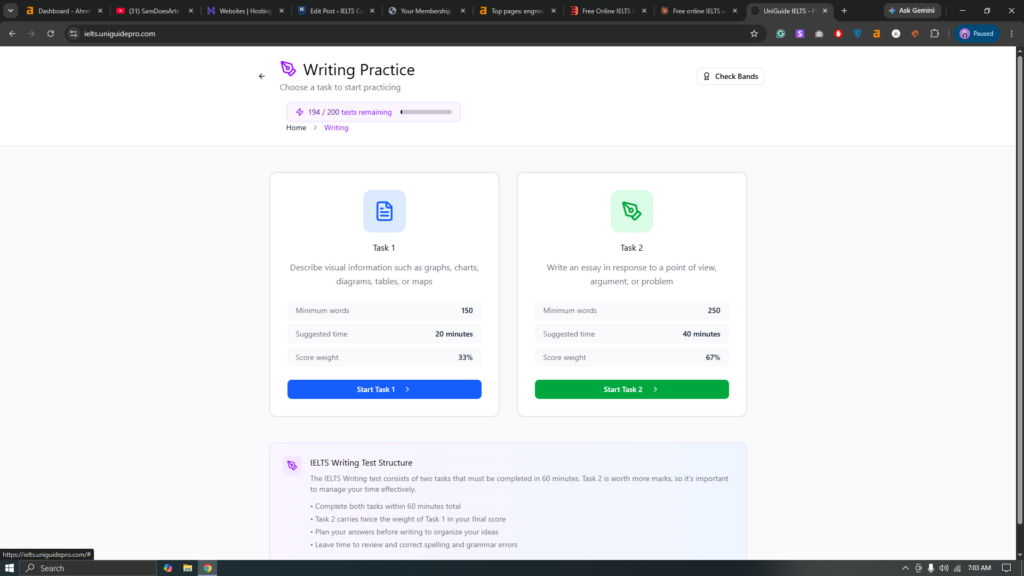
What Is the IELTS Writing Test? A Complete Overview
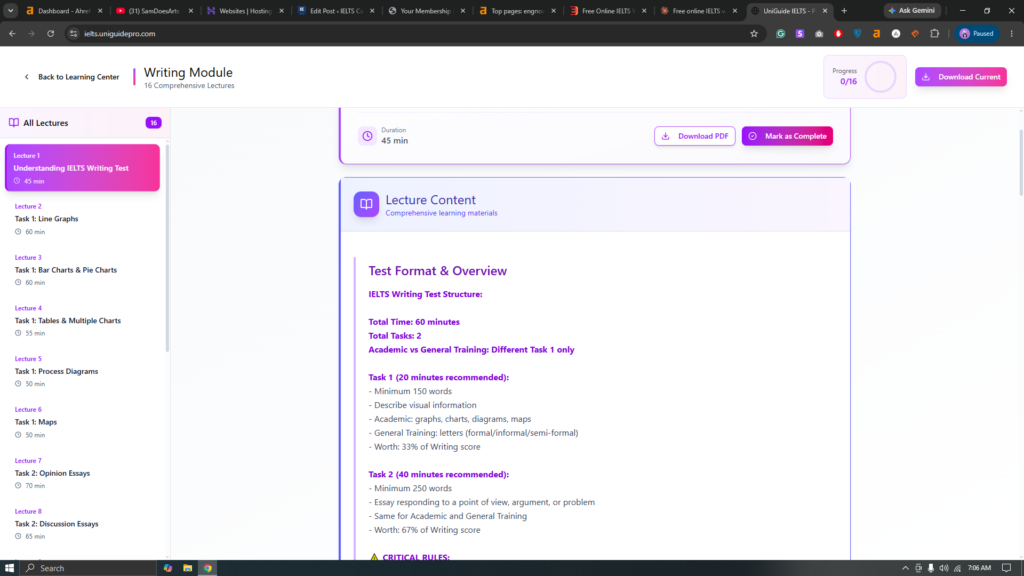
The IELTS (International English Language Testing System) Writing test is one of four components of the exam, alongside Listening, Reading, and Speaking. It is available in two versions:
- IELTS Academic — For students applying to universities, colleges, or professional registration bodies.
- IELTS General Training — For those seeking work experience, secondary education, or immigration to English-speaking countries such as Canada, Australia, the UK, and New Zealand.
Both versions include two writing tasks completed within 60 minutes.
IELTS Academic Writing
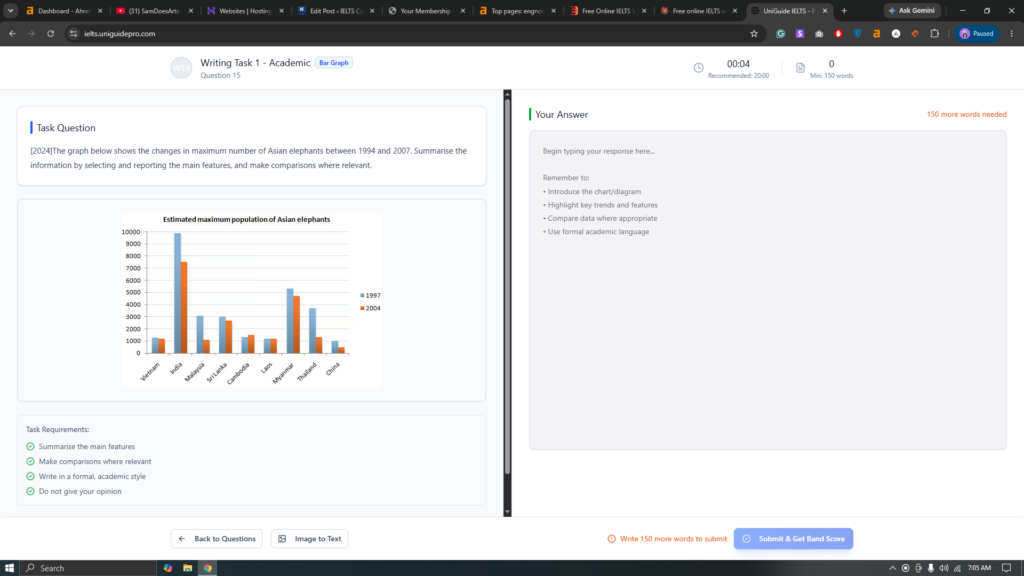
- Task 1 (20 minutes, 150 words minimum): Candidates describe, summarise, or explain visual information — a graph, chart, table, map, or diagram.
- Task 2 (40 minutes, 250 words minimum): Candidates write an essay in response to a point of view, argument, or problem.
IELTS General Training Writing
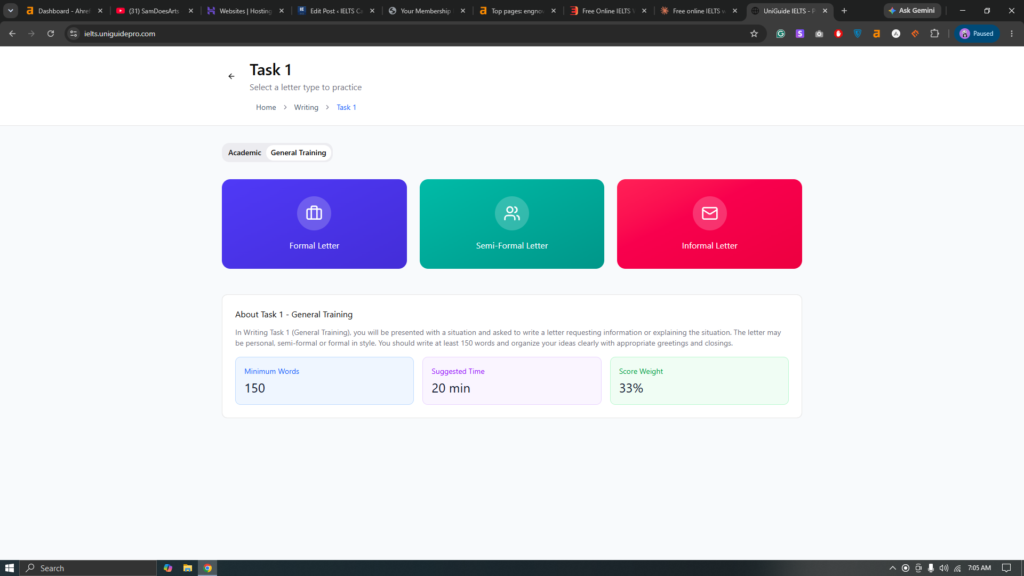
- Task 1 (20 minutes, 150 words minimum): Candidates write a letter — formal, semi-formal, or informal — in response to a given situation.
- Task 2 (40 minutes, 250 words minimum): Candidates write an essay similar to the Academic version, though topics tend to be slightly less complex.
Task 2 carries twice the marks of Task 1, making it the more critical component of your Writing score.
Why Use a Free Online IELTS Writing Test Collection?
Practising with real and realistic IELTS Writing tests is not optional — it is essential. Here is why a well-organised free online collection can transform your preparation:
1. Familiarity with Exam Conditions
By practising timed tests regularly, you train yourself to manage 60 minutes efficiently. Many candidates run out of time during the actual exam simply because they have never practised under real conditions.
2. Exposure to a Wide Range of Topics
IELTS Writing Task 2 covers topics from education and technology to environment, health, globalisation, and society. A large collection of past test papers exposes you to all these themes so no question catches you off guard.
3. Understanding Band Descriptors
Each time you write a practice response, you can compare it against official IELTS Band Descriptors. This builds self-awareness and helps you pinpoint exactly where you are losing marks.
4. Zero Cost, Maximum Value
High-quality IELTS preparation courses can cost hundreds of dollars. A curated free online collection gives you the same exposure to authentic question types at absolutely no cost.
The Four Marking Criteria: What Examiners Look For
To make the most of any free IELTS Writing test collection, you must understand how your work is assessed. IELTS Writing is marked on four equally weighted criteria, each scored from Band 1 to Band 9:
1. Task Achievement / Task Response
- Task 1: Did you cover all the key features of the visual information? Is your overview accurate?
- Task 2: Did you fully address all parts of the question? Is your position clear and well-supported?
Common mistake: Writing about only one part of a two-part question. This can cap your Task Response score at Band 5.
2. Coherence and Cohesion
This criterion evaluates how logically your ideas are organised and how smoothly your writing flows. Examiners look for:
- Clear paragraph structure (introduction, body paragraphs, conclusion)
- Effective use of linking words and discourse markers (however, furthermore, in contrast, as a result)
- Appropriate use of reference and substitution to avoid repetition
Tip: Aim for four to five well-developed paragraphs in Task 2, each with a clear central idea.
3. Lexical Resource
This assesses your range and accuracy of vocabulary. High-scoring responses demonstrate:
- Precise and topic-specific word choice
- Collocations used correctly (e.g., “address a problem,” not “solve a problem”)
- Rare errors in spelling and word formation
Tip: Do not use the same word twice in the same paragraph. Develop a habit of paraphrasing and using synonyms effectively.
4. Grammatical Range and Accuracy
This criterion rewards candidates who use a variety of grammatical structures accurately. This includes:
- Complex sentences with subordinate clauses
- Conditional structures (If…, then…)
- Passive constructions
- Relative clauses (which, who, that)
Tip: One well-constructed complex sentence is worth more than three simple sentences with the same meaning.
Types of Questions in a Free IELTS Writing Test Collection
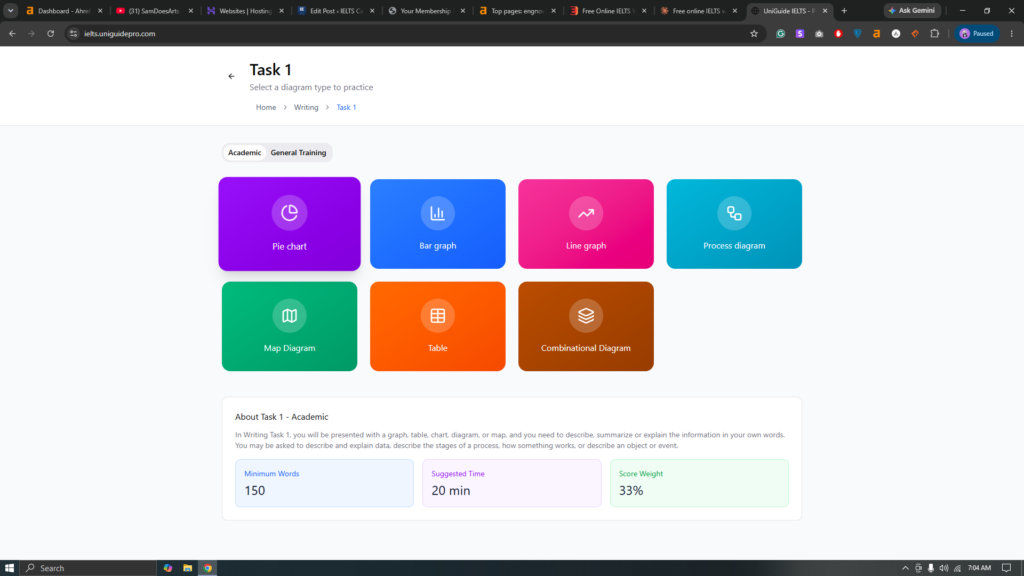
Academic Task 1 Question Types
A comprehensive free collection should include all of the following visual types:
| Visual Type | What You Describe |
|---|---|
| Line Graph | Trends over time |
| Bar Chart | Comparisons between categories |
| Pie Chart | Proportions and percentages |
| Table | Multiple sets of data |
| Map | Changes to a location over time, or two different places |
| Process Diagram | How something is made or how a natural process works |
| Mixed Visuals | Two different chart types presented together |
Academic Task 2 Essay Types
| Essay Type | Task Instruction Keywords |
|---|---|
| Opinion / Agree or Disagree | “To what extent do you agree or disagree?” |
| Discussion | “Discuss both views and give your own opinion.” |
| Problem and Solution | “What are the problems? What solutions can you suggest?” |
| Advantages and Disadvantages | “What are the advantages and disadvantages?” |
| Two-Part Question | Two directly stated questions in the prompt |
General Training Task 1 Letter Types
| Letter Type | Relationship to Recipient | Tone |
|---|---|---|
| Formal | Unknown authority or organisation | Formal |
| Semi-Formal | Known professional or acquaintance | Polite, neutral |
| Informal | Close friend or family member | Friendly, natural |
Top Free Online IELTS Writing Test Collections and Resources
1. British Council IELTS Practice Materials
The British Council — one of the two organisations that administers IELTS — provides free sample Writing questions on its official website. These are authentic in format and difficulty, making them ideal for serious test preparation.
Best for: Understanding what a genuine IELTS question looks like.
2. IDP IELTS Sample Tests
IDP Education, the other IELTS administrator, offers free sample tests and practice materials through its website and the IELTS Official app. Some materials include annotated sample answers with examiner feedback.
Best for: Seeing band-level model answers with commentary.
3. IELTS.org Practice Tests
The official IELTS website (ielts.org) publishes free sample questions for both Academic and General Training. While the full test is locked behind a fee, the Writing samples are accessible at no cost.
Best for: First-time test-takers getting oriented with the format.
4. IELTS Liz (ieltsliz.com)
IELTS Liz is one of the most popular free IELTS preparation blogs in the world, maintained by a former IELTS examiner. It contains:
- Hundreds of Writing Task 1 and Task 2 model answers
- Tips and lessons organised by essay type
- Free video lessons explaining each band descriptor
Best for: Learners who want detailed explanations alongside practice questions.
5. IELTS Simon (ielts-simon.com)
Run by a former IELTS examiner, this site offers daily lessons with model answers. The approach emphasises simplicity and clarity over complex vocabulary — a strategy that has helped thousands of students achieve Band 7+.
Best for: Students targeting Band 6.5 to 7.5 who want a practical, no-nonsense approach.
6. IELTS Buddy (ieltsbuddy.com)
IELTS Buddy provides a large bank of free practice tests, model essays, and interactive exercises. It is particularly well-organised by task type and topic.
Best for: Structured self-study with clear categorisation by topic and question type.
7. Cambridge IELTS Books (Available in Libraries)
The Cambridge IELTS Practice Tests series (Books 1 through 19 as of 2024) contains real past IELTS papers. Many public libraries provide free access to these books, and older editions are widely available online.
Best for: Practising with the most authentic tests available, especially for simulating exam conditions.
8. Road to IELTS (British Council)
A more structured digital learning platform from the British Council. A limited free version is available that includes practice tasks, videos, and immediate feedback tools.
Best for: Candidates who prefer a guided, app-style learning experience.
How to Use a Free IELTS Writing Test Collection Effectively
Accessing a collection of free tests is only the first step. How you practise matters more than how much you practise.
Step 1: Diagnose Your Starting Point
Before beginning any structured practice, write one Task 1 and one Task 2 response under timed conditions. Use the official Band Descriptors to assess your own work honestly, or share it in an online IELTS forum for peer feedback.
Step 2: Study Model Answers — Then Analyse, Not Memorise
Read model answers from IELTS Liz or IELTS Simon and ask yourself:
- How is the essay structured?
- What vocabulary is used and why?
- How does the writer link ideas between sentences and paragraphs?
- What grammatical structures appear frequently?
Never memorise model answers. IELTS examiners are trained to spot memorised responses, which can lead to a significantly lower score.
Step 3: Focus on One Skill at a Time
Rather than trying to improve everything at once, dedicate each week to one criterion:
- Week 1: Task Achievement — practise identifying all parts of the question and addressing each one
- Week 2: Coherence — practise outlining and paragraph structure
- Week 3: Lexical Resource — build vocabulary by topic (environment, health, technology, education)
- Week 4: Grammar — practise writing complex sentences and review your errors
Step 4: Time Every Practice Session
Always write Task 1 in 20 minutes and Task 2 in 40 minutes. Never give yourself extra time. Time management is a skill that only improves through disciplined repetition.
Step 5: Review and Rewrite
After every practice response, review it against band descriptors, identify two or three specific weaknesses, and rewrite the weakest paragraph. This cycle of write → review → rewrite is the most efficient way to improve.
Step 6: Seek Qualified Feedback
Free online IELTS communities on Reddit (r/IELTS), Facebook groups, and forums like IELTS-Blog allow you to submit writing samples for peer review. For more reliable feedback, consider occasional paid essay corrections from a certified IELTS teacher.
Common IELTS Writing Mistakes and How to Avoid Them
Mistake 1: Writing Under 150 or 250 Words
Going below the minimum word count results in an automatic penalty. Always write slightly above — 165–180 words for Task 1 and 270–290 words for Task 2.
Mistake 2: Copying the Question
Many candidates copy phrases directly from the question prompt. This is wasteful and examiners do not count copied words. Always paraphrase the question in your introduction.
Mistake 3: Using Informal Language
IELTS Writing expects a formal or semi-formal academic register. Avoid contractions (don’t → do not), slang, and overly casual phrasing.
Mistake 4: Lacking a Clear Overview in Task 1
Every Task 1 Academic response must include an overview — a statement that summarises the most significant trends or features without specific data. Missing this paragraph caps your score at Band 5.
Mistake 5: Presenting Personal Opinions in Task 1
Task 1 is purely descriptive. Never say “I think this graph shows…” or express judgements about the data. Stick to objective language.
Mistake 6: Memorising Templates
Rigid templates can harm your score if they do not fit the specific question. Use a flexible framework, not a memorised script.
Mistake 7: Ignoring Spelling and Punctuation
A high frequency of spelling errors directly affects your Lexical Resource score. Proofread every response before your time runs out — even 90 seconds of review can catch significant errors.
Band Score Breakdown: What Does Each Band Mean in Writing?
| Band | Description | Typical Profile |
|---|---|---|
| Band 9 | Expert user | Near-perfect responses; rare |
| Band 8 | Very good user | Occasional inaccuracies; very rare |
| Band 7 | Good user | Some errors; generally handles complex language |
| Band 6 | Competent user | Effective use of language despite imprecision |
| Band 5 | Modest user | Partial command; frequent errors |
| Band 4 | Limited user | Basic conveying of meaning; many errors |
Most universities accept Band 6.0–7.0. Immigration to Australia and Canada often requires Band 6.0–7.0. Professional registration (medical, legal, nursing) may require Band 7.0–8.0.
Sample IELTS Writing Task 2 Question and High-Band Response
Question
Some people believe that the government should make higher education free for all citizens. Others think that students should pay for their own university education. Discuss both views and give your own opinion.
Sample Band 7+ Response
Introduction:
The question of whether tertiary education should be funded by the state or by individual students is fiercely debated across the world. While there are merits to both positions, I believe that a hybrid funding model offers the most equitable solution.
Body Paragraph 1 — View 1 (Free education):
Proponents of free higher education argue that it promotes social equality by ensuring that financial background does not determine a person’s access to knowledge and career opportunities. In countries such as Germany and Norway, where university tuition is state-funded, graduation rates are high across all income groups. Furthermore, a more educated population generates broader economic benefits, as graduates tend to contribute more in taxes over their lifetimes than the cost of their education.
Body Paragraph 2 — View 2 (Student-funded education):
On the other hand, those who believe students should bear the cost of their own education contend that individuals who benefit most directly from a degree should contribute to its cost. This model, as seen in countries like the United States and Australia, encourages students to make informed choices about their field of study, potentially reducing enrolment in courses with limited employment prospects.
Body Paragraph 3 — Personal Opinion:
In my view, neither extreme is entirely satisfactory. Completely free education strains public finances, while full private funding excludes talented students from disadvantaged backgrounds. A means-tested scholarship system combined with income-contingent loan repayments — repaid only once graduates reach a sufficient salary threshold — strikes the most reasonable balance between accessibility and fiscal responsibility.
Conclusion:
In conclusion, while both free and privately funded higher education have their advantages, a nuanced approach that combines public subsidy with individual contribution is likely to produce the fairest and most sustainable outcomes.
(Word count: approximately 285 words)
IELTS Writing Preparation Schedule: 8-Week Study Plan
| Week | Focus | Activities |
|---|---|---|
| 1 | Exam format and marking criteria | Read band descriptors, complete one diagnostic test |
| 2 | Task 1 — Graphs and Charts | Practice 5 Task 1 responses; study model answers |
| 3 | Task 1 — Maps and Processes | Practice 5 Task 1 responses; focus on process language |
| 4 | Task 2 — Opinion and Discussion Essays | Write 4 essays; review coherence and structure |
| 5 | Task 2 — Problem/Solution and Advantages/Disadvantages | Write 4 essays; focus on lexical resource |
| 6 | Task 2 — Two-Part Questions | Write 4 essays; focus on grammar variety |
| 7 | Full timed practice tests | Complete 4 full Writing sessions (Task 1 + Task 2) under exam conditions |
| 8 | Review and refinement | Identify persistent weaknesses; targeted rewriting practice |
Frequently Asked Questions About Free Online IELTS Writing Tests
Are free online IELTS writing tests accurate to the real exam?
The most reliable free resources are those from the British Council, IDP, and the official IELTS website, as they use authentic question formats. Third-party sites vary in quality — always cross-check topics and formats against official materials.
How many practice tests should I complete before the exam?
Aim for a minimum of 20–30 timed writing sessions over your preparation period. Quality of review matters more than quantity of tests completed.
Can I improve my IELTS Writing score in one month?
Yes, but only with intensive, targeted practice. A dedicated four-week plan that includes daily writing, consistent review of model answers, and regular feedback can realistically add 0.5 to 1.0 band to your score.
Do IELTS Writing topics repeat?
IELTS does not officially recycle questions, but themes repeat regularly — technology, environment, education, health, cities, and globalisation appear across many test dates. A large practice collection ensures you are familiar with all recurring themes.
Is IELTS Writing marked by a human?
Yes. Unlike Listening and Reading, IELTS Writing is always marked by a trained human examiner. Computer-marked writing (e.g., IELTS Online) also undergoes human verification.
Conclusion: Start Practising Today
The path to a high IELTS Writing score is built on consistent, reflective practice. A free online IELTS Writing test collection gives you access to hundreds of authentic question types, model answers, and topic-specific vocabulary resources — all at no cost. The key is not simply to practise, but to practise deliberately: time your responses, review them critically, study model answers analytically, and focus on one weakness at a time.
Whether your target is Band 6 or Band 8.5, the resources are available to help you get there. Start your practice today, commit to the process, and approach every task as an opportunity to refine your skills.
Keywords: free online IELTS writing test, IELTS writing practice test, IELTS writing test collection, IELTS writing task 1 practice, IELTS writing task 2 practice, free IELTS writing samples, IELTS writing band score, IELTS Academic writing test, IELTS General Training writing, IELTS writing tips, how to improve IELTS writing score