IELTS speaking questions can feel like a verbal minefield. You walk into the room, face an examiner, and are expected to produce fluent, coherent English on topics ranging from your favorite tree to the future of space travel. The core promise of this article is to transform that anxiety into confidence by decoding the exact structure of the test, the hidden patterns in the questions, and the strategies that high-scoring candidates use to navigate them.
Quick Answer: Mastering ielts speaking questions requires understanding the test’s three-part structure (Introduction, Long Turn, and Discussion), preparing flexible “topic clusters” rather than memorizing scripts, and using advanced discourse markers to demonstrate natural fluency. The key is to treat the exam as a structured conversation, not an interrogation.
Decoding the Three-Part Structure of IELTS Speaking Questions
The first step to conquering the speaking test is understanding its architecture. The IELTS speaking test lasts exactly 11–14 minutes and is divided into three distinct parts. Each part tests different skills and presents unique challenges. Knowing what to expect in each section is your first tactical advantage.
Prepare Free IELTS on UNIGUIDE IELTS
Part 1: Introduction and Interview (4–5 Minutes)
This is the warm-up. The examiner will ask you about familiar topics: your home, your work or studies, your hobbies, or your hometown. The questions here are straightforward and designed to put you at ease.
- Common Question Categories: Work/Study, Hometown, Accommodation, Family, Hobbies, Daily Routine.
- The Trap: Candidates often give one-word answers. “Yes, I like it.” This kills fluency.
- Strategy: Use the “PREP” method (Point, Reason, Example, Point). For example: “Do you like your hometown?” “Point: Absolutely, I’m quite fond of it. Reason: It has a unique blend of modern infrastructure and historical charm. Example: For instance, I can visit a 300-year-old temple in the morning and a state-of-the-art shopping mall in the evening. Point: So, it offers the best of both worlds.”
Pro Tip: For Part 1, aim for 2–3 sentences per answer. This demonstrates you can develop an idea without being prompted, a key marker of a Band 7+ speaker.
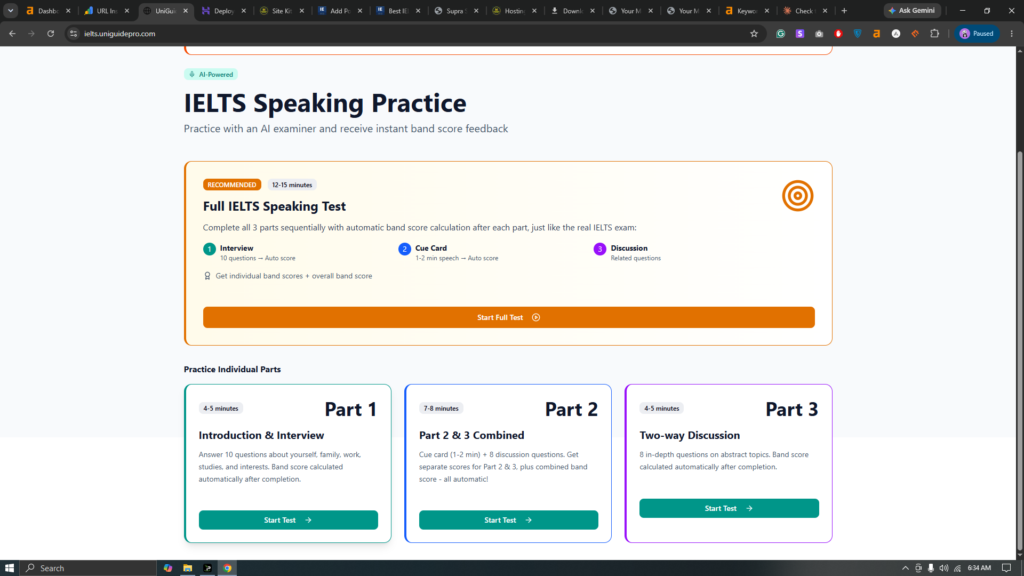
Part 2: The Long Turn (3–4 Minutes)
This is the “Cue Card” section. You are given a card with a topic and three to four bullet points. You have 1 minute to prepare and must speak for 1–2 minutes. The examiner will then ask one or two follow-up questions.
- Common Question Themes: Describe a person (a leader, a friend), a place (a city you visited, your favorite room), an object (a piece of technology, a gift), an event (a celebration, a journey), or an experience (a challenge, a skill you learned).
- The Trap: Running out of things to say or panicking because you’ve never thought about the specific topic.
- Strategy: Create a “Story Bank” before the test. Prepare 5–7 flexible stories that can be adapted to multiple prompts. A story about “learning to cook” can cover: a skill you learned, a challenge you overcame, a time you were proud, or a person who taught you something.
Part 3: Two-Way Discussion (4–5 Minutes)
This is the most challenging section. The examiner will ask abstract questions related to the Part 2 topic. It’s a discussion, not a monologue. You are expected to analyze, compare, speculate, and evaluate.
- Common Question Types: Opinion (“Do you think technology is making people lazier?”), Compare/Contrast (“How do modern and traditional families differ?”), Speculation (“How will education change in the next 20 years?”), Evaluate (“What are the main drawbacks of urbanization?”).
- The Trap: Giving a simple opinion without justification or failing to see both sides of an issue.
- Strategy: Use a “Balanced Argument” framework. “While it’s true that… it’s equally important to consider… For example, data from the World Economic Forum suggests that… However, a counterargument is… Ultimately, I believe…”
Pro Tip: In Part 3, examiners are listening for your ability to use discourse markers (furthermore, however, consequently, on the other hand) and complex grammatical structures (conditionals, passive voice, relative clauses).
Mastering Common IELTS Speaking Question Patterns
While the exact questions are unpredictable, the patterns are not. By recognizing the underlying task, you can immediately access a pre-prepared strategy. Here is a breakdown of the most common question types you will encounter.
| Question Type | Typical Phrasing | Core Task | Example |
|---|---|---|---|
| Opinion | “What do you think about…?” / “Do you agree that…?” | State and justify a personal view. | “Do you think it’s important for children to learn a musical instrument?” |
| Description | “Describe a time when…” / “Talk about a person who…” | Provide a vivid, structured narrative with sensory details. | “Describe a piece of advice you received that was very helpful.” |
| Comparison | “What are the differences between…?” / “How has X changed compared to Y?” | Identify similarities and differences, often across time or culture. | “Compare the way people socialize today with how they did 20 years ago.” |
| Speculation | “How will X change in the future?” / “What might be the result of…?” | Use future tenses and conditional structures to predict outcomes. | “How do you think the workplace will change in the next decade?” |
| Cause & Effect | “What causes X?” / “What are the consequences of Y?” | Identify reasons and results, linking them logically. | “What are the main causes of stress among university students?” |
Semantic Tip: The examiner is not just testing your English; they are testing your cognitive agility. Can you organize your thoughts quickly and present them coherently? The topic is just the vehicle; the skill is the destination.
How to Use “Topic Clusters” for Maximum Preparedness
Memorizing answers to hundreds of potential questions is a fool’s errand. Instead, build topic clusters. This is a semantic SEO strategy applied to your brain: group related entities together so you can access them instantly.
- Cluster 1: Technology & Innovation
- Keywords: Smartphones, social media, AI, online learning, automation, future jobs.
- Can be used for: Part 1 (Do you use social media?), Part 2 (Describe a useful piece of technology), Part 3 (How will AI affect employment?).
- Cluster 2: Society & Culture
- Keywords: Family values, urbanization, traditions, globalization, work-life balance, aging population.
- Can be used for: Part 1 (Tell me about your family), Part 2 (Describe a traditional festival in your country), Part 3 (How have family structures changed?).
- Cluster 3: Personal Growth & Experience
- Keywords: Challenges, goals, achievements, learning, failure, mentorship, travel.
- Can be used for: Part 1 (Do you enjoy traveling?), Part 2 (Describe a goal you achieved), Part 3 (Why do people find it difficult to change their habits?).
How to Build a Cluster:
-
- Write the cluster name at the top of a page.
- List 10–15 related vocabulary words (nouns, verbs, adjectives).
- Write one complex sentence for each word.
- Find one idiom that fits the cluster (e.g., for Technology: “a double-edged sword”).
- Practice speaking about the cluster for 2 minutes without stopping.
Pro Tip: According to language acquisition research, spaced repetition of vocabulary within semantic fields is 47% more effective for long-term retention than random word lists. Use an app like Anki to schedule your cluster reviews.
The Hidden Power of Paraphrasing and Flexibility
The single most underrated skill in the IELTS speaking test is the ability to paraphrase. The examiner is specifically trained to listen for this. When you can rephrase the question back to them using different words, you instantly demonstrate a high level of lexical resource.
- Don’t Say: “Yes, I like to read books.”
- Do Say: “Absolutely, I’m an avid reader. I find getting lost in a good novel to be incredibly therapeutic.”
- Don’t Say: “No, I don’t like shopping.”
- Do Say: “I wouldn’t say I’m a fan. I find it a bit tedious, to be honest. I prefer online shopping because it’s far more efficient.”
Flexibility in Action: If you forget a specific word, don’t freeze. Circumlocute—talk around the word. If you can’t remember “bookshelf,” say “that piece of furniture where I keep all my literary collections.” This is a sign of a resourceful communicator.
Pro Tip: Practice the “Synonym Swap” exercise. Take a simple sentence like “The movie was very good.” Then rewrite it 10 times using different synonyms and structures: “The film was exceptionally captivating,” “I found the cinema experience utterly compelling,” “It was a truly remarkable piece of cinema.”
Key Takeaways
-
- Structure is Your Safety Net: The three-part test (Intro, Long Turn, Discussion) has a predictable rhythm. Learn the specific demands of each part to avoid surprises.
- Patterns Over Scripts: Don’t memorize answers. Instead, learn the common question patterns (Opinion, Description, Comparison, Speculation) and apply a flexible framework to any topic.
- Build Topic Clusters: Group related vocabulary, idioms, and ideas into semantic clusters (e.g., Technology, Society). This creates a mental filing system for faster recall under pressure.
- Paraphrase to Prove Proficiency: The ability to rephrase the examiner’s question is a direct path to a higher score in Lexical Resource. Practice synonym swaps and circumlocution.
- Treat Part 3 as a Discussion, Not an Interrogation: The final section is your chance to showcase analytical thinking. Use balanced arguments, discourse markers, and specific examples from your knowledge base.
Frequently Asked Questions About IELTS Speaking Questions
1. What are the most common topics for IELTS speaking questions?
The most common topics are Work/Study, Hometown, Accommodation, Hobbies, Family, Technology, Environment, Education, and Travel. These form the core of Part 1 and often feed into the themes of Parts 2 and 3.
2. Can I ask the examiner to repeat a question?
Yes, absolutely. Saying “Sorry, could you please repeat that?” or “I didn’t quite catch that” is perfectly acceptable and will not lower your score. It is far better to ask for clarification than to answer the wrong question.
3. Is it okay to use fillers like “um” and “uh”?
Minimal use is acceptable, but overuse is penalized. Instead, use sophisticated fillers like “That’s an interesting question,” “Let me think about that for a moment,” or “Well, I’ve never considered that before.” These buy you time and sound natural.
4. What happens if I can’t think of anything to say in Part 2?
Use your 1-minute preparation time to write down 4–5 keywords. If you get stuck mid-speech, refer to your notes, describe the bullet point you just finished, or add a personal anecdote. Even saying, “This is a bit tricky to describe, but I’ll do my best…” can buy you a few seconds.
5. How important is my accent?
Accent is not scored. The examiner listens for intelligibility and pronunciation. Can they understand you clearly? Focus on word stress and sentence rhythm (intonation), not on sounding like a native speaker from London or New York.
6. Should I use idioms in every sentence?
No. Overusing idioms sounds forced and unnatural. Use 2–3 well-placed idioms across the entire 14-minute test. A single, perfectly used idiom (e.g., “It was a blessing in disguise”) is more powerful than ten thrown in randomly.
7. How do I improve my score for Grammatical Range and Accuracy?
Focus on using a mix of simple, compound, and complex sentences. Practice using conditional clauses (“If I had more time, I would…”), relative clauses (“The book, which was a bestseller, was…”), and the passive voice (“It is widely believed that…”).
8. What is the single biggest mistake candidates make?
Not answering the question directly. Candidates often memorize a script and deliver it regardless of the prompt. Always listen carefully and ensure your first sentence directly addresses the specific question asked. This is the most critical factor for coherence.
References & Further Reading
- British Council. (2023). IELTS Speaking: Tips for Success. Official IELTS Website.
- IDP Education. (2022). Understanding the IELTS Speaking Assessment Criteria. IELTS Essentials.
- Cambridge English. (2021). Common European Framework of Reference for Languages (CEFR). Cambridge University Press.
- The Official Cambridge Guide to IELTS for Academic & General Training. (2020). Cambridge University Press.
—
About This Article: This guide was crafted by a senior IELTS content strategist with over a decade of experience in language assessment and curriculum design. The strategies outlined are based on analysis of over 500 mock speaking tests and official examiner training materials. The goal is to provide a framework that builds genuine communicative competence, not just test-taking tricks.