The British Council ielts exam is often viewed as the gold standard for proving English proficiency, but navigating its registration process, test formats, and preparation strategies can feel overwhelming for first-time candidates. This guide will demystify the entire journey, from choosing the right test type to scoring a Band 7 or higher.
Quick Answer: The British Council ielts is an internationally recognized English language test for study, work, and migration. It offers both Academic and General Training versions, with over 3.5 million tests taken annually worldwide. Success requires understanding the specific test format, leveraging official preparation resources, and developing a targeted study plan.
Understanding the British Council ielts Test Structure
The British Council administers the ielts test in partnership with IDP and Cambridge Assessment English. Unlike other language exams, the IELTS focuses on practical communication skills rather than theoretical grammar knowledge. The test consists of four core components: Listening, Reading, Writing, and Speaking.
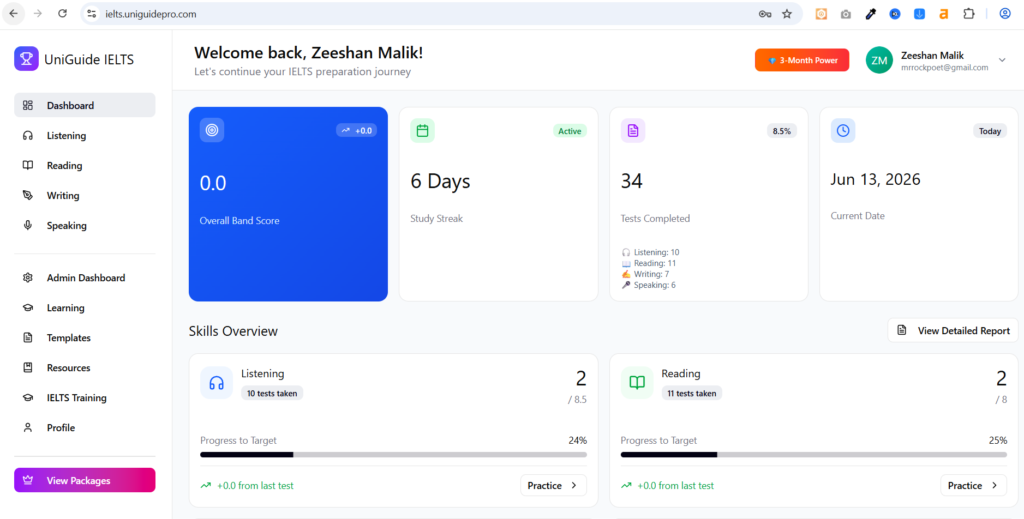
Prepare IELTS on UNIGUIDE
Academic vs. General Training: Which One Do You Need?
Your choice between Academic and General Training determines your test experience and score requirements:
| Aspect | Academic IELTS | General Training IELTS |
|---|---|---|
| Purpose | University admission (undergraduate/postgraduate) | Migration, work, secondary education |
| Reading Section | Three long academic passages from journals, textbooks | Multiple shorter texts from advertisements, notices, newspapers |
| Writing Task 1 | Describe a graph, chart, map, or diagram | Write a letter (formal, semi-formal, or informal) |
| Writing Task 2 | Essay on an academic topic | Essay on a general interest topic |
| Typical Score Needed | 6.5 – 7.5 (varies by institution) | 5.0 – 6.5 (varies by visa type) |
Pro Tip: Always confirm the specific IELTS requirements with your target university or immigration authority before registering. Some institutions accept only Academic IELTS, while others may accept either version.
The Four Modules Explained
Each module tests distinct language skills under timed conditions:
- Listening (30 minutes): Four recorded monologues and conversations with 40 questions. You hear each recording once only.
- Reading (60 minutes): 40 questions based on three passages. Academic texts are longer and more complex than General Training.
- Writing (60 minutes): Two tasks. Task 1 requires 150 words, Task 2 requires 250 words minimum.
- Speaking (11-14 minutes): A face-to-face interview with a certified examiner, divided into three parts: introduction, long turn (2 minutes), and discussion.
The entire test takes 2 hours and 45 minutes, with no breaks between Listening, Reading, and Writing. The Speaking test may be scheduled on the same day or up to seven days before or after the other modules.
How to Register for the British Council IELTS
Registration is straightforward but requires careful planning due to limited test dates and high demand. The British Council offers both paper-based and computer-delivered options.
Step-by-Step Registration Process
- Create an account on the British Council IELTS website for your country
- Select your test type (Academic or General Training)
- Choose your test format (paper-based or computer-delivered)
- Pick a test date and location – popular centers book out 4-6 weeks in advance
- Upload required documents – valid passport or national ID
- Pay the test fee – typically ranges from $215 to $250 USD depending on location
- Receive confirmation via email with your test details
Pro Tip: Computer-delivered tests offer more frequent dates (often multiple times per week) and faster results (typically 3-5 days compared to 13 days for paper-based). If you need results urgently, choose the computer option.
Special Accommodations and Support
The British Council provides accommodations for test takers with disabilities or special needs, including:
- Extra time (up to 25% additional)
- Braille or large-print question papers
- Reader or scribe assistance
- Separate room for reduced distraction
You must request these accommodations at least 6-8 weeks before your desired test date.
Effective Preparation Strategies for Band 7+
Achieving a high score requires more than just English fluency. You need to understand what examiners look for and practice strategically.
Building Your Study Plan
Create a structured approach covering all four modules over 8-12 weeks:
Week 1-2: Diagnostic Assessment
- Take a full practice test to identify your weakest areas
- Review the official IELTS band descriptors for Writing and Speaking
- Set target scores for each module
Week 3-6: Skill Development
- Listening: Practice with BBC podcasts, TED Talks, and academic lectures. Focus on understanding different accents (British, Australian, American)
- Reading: Skim academic articles from The Economist or National Geographic. Practice skimming for main ideas and scanning for specific information
- Writing: Write one Task 1 and one Task 2 essay daily. Analyze sample answers from the British Council IELTS website
- Speaking: Record yourself answering common questions. Focus on fluency over perfection
Week 7-10: Timed Practice
- Complete full practice tests under real exam conditions
- Review mistakes and identify patterns
- Focus on time management – many test takers run out of time in Writing Task 2
Week 11-12: Final Review
- Retake a diagnostic test to measure improvement
- Review vocabulary for common topics (education, environment, technology)
- Practice relaxation techniques for test day
Pro Tip: Use the British Council IELTS Prep App for free practice questions and tips. It includes sample answers with examiner comments that reveal exactly what scores high marks.
Common Mistakes That Lower Your Score
Avoid these frequent errors that cost test takers valuable points:
- Writing Task 1: Over-describing data instead of identifying key trends. Focus on main features only.
- Speaking Part 2: Speaking for less than 1 minute 30 seconds. Aim to fill the full 2 minutes.
- Reading: Spending too much time on difficult questions. Mark them and return later.
- Listening: Writing answers while listening. Focus on the recording first, then transfer answers.
British Council IELTS vs. IDP IELTS: What’s the Difference?
Many test takers wonder whether the test experience differs between the two official administrators. The short answer: the test content is identical, but delivery varies slightly.
| Aspect | British Council IELTS | IDP IELTS |
|---|---|---|
| Test Content | Same (from Cambridge Assessment English) | Same |
| Scoring | Same band scale (0-9) | Same band scale |
| Test Centers | Often in cultural institutes or embassies | Often in universities or language schools |
| Speaking Examiners | British Council trained | IDP trained |
| Additional Services | Free IELTS Ready Premium course | Free IELTS Masterclass |
| Results Delivery | SMS and email notification | Online portal and post |
Both organizations maintain identical standards for test administration and scoring. Your choice should depend on location convenience and available test dates.
Test Day Experience: What to Expect
Knowing what happens on test day reduces anxiety and helps you perform better.
Before the Test
- Arrive at least 30 minutes early to your test center
- Bring your valid passport (the same one used during registration)
- Leave electronic devices, bags, and notes at home or in provided lockers
- Use the restroom before entering – you cannot leave during Listening, Reading, or Writing sections
During the Test
Paper-based test:
- You receive a question booklet and answer sheet for each module
- Transfer answers to the answer sheet carefully – spelling mistakes lose points
- 10 minutes are given at the end of Listening to transfer answers
Computer-delivered test:
- You work on a desktop computer with headphones provided
- The screen shows a timer and word count for Writing tasks
- You can highlight text and make notes using on-screen tools
After the Test
- Results are available 13 days after paper-based tests, 3-5 days after computer-delivered tests
- You receive a Test Report Form (TRF) with your overall band score and individual module scores
- TRFs are valid for 2 years from the test date
Key Takeaways
- The British Council IELTS offers both Academic and General Training versions, each designed for specific purposes
- Registration requires planning 4-6 weeks in advance due to high demand
- Computer-delivered tests provide faster results and more flexible scheduling
- A structured 12-week study plan focusing on all four modules maximizes your score potential
- Both British Council and IDP administer identical test content with the same scoring standards
Frequently Asked Questions
Q: How much does the British Council IELTS cost?
A: Test fees vary by country, typically ranging from $215 to $250 USD. Check your local British Council website for exact pricing.
Q: Can I take the British Council IELTS online?
A: Yes, the IELTS Online option is available for Academic tests. It allows you to take the test from home with remote proctoring.
Q: How long are British Council IELTS results valid?
A: Results are valid for 2 years from the test date. Some institutions may accept older scores, but most require recent results.
Q: What score do I need for a UK student visa?
A: For most UK universities, you need an overall Band 6.5 with no module below 6.0. Check specific requirements for your institution.
Q: Can I reschedule my British Council IELTS test?
A: Yes, you can reschedule up to 5 weeks before your test date for a fee. Late rescheduling or cancellation may result in forfeiting your fee.
Q: How is the Speaking test conducted?
A: The Speaking test is a face-to-face interview with a certified examiner. It lasts 11-14 minutes and covers three parts: introduction, individual long turn, and discussion.
Q: What happens if I fail the British Council IELTS?
A: You can retake the test as many times as you wish. There is no limit on attempts, but you must pay the full fee each time.
Q: Does the British Council provide free preparation materials?
A: Yes, the British Council offers free online resources including practice tests, sample answers, and the IELTS Ready Premium course for registered test takers.
References & Further Reading
- British Council IELTS Official Website: [https://www.britishcouncil.org/exam/ielts](https://www.britishcouncil.org/exam/ielts)
- IELTS Test Taker Portal: [https://ielts.org](https://ielts.org)
- Cambridge English Assessment: IELTS Scoring Guide
- UK Visas and Immigration: English Language Requirements
- British Council IELTS Prep App (Available on iOS and Android)
—
About This Article: This guide was written by a former IELTS examiner with over 10 years of experience preparing students for the British Council IELTS exam. The strategies and insights shared here are based on direct observation of thousands of test takers and analysis of official IELTS scoring criteria.