Platform: ielts.uniguidepro.com Category: IELTS Academic Writing | Task 1 Tips & Tools Reading Time: ~10 minutes
Introduction: Why Your Task 1 Report Needs a Second Set of Eyes
You’ve spent 20 minutes writing your IELTS Academic Writing Task 1 report. You described the graph, highlighted key trends, made comparisons — and now you’re wondering: Is this actually good enough for a Band 7 or higher?
That question haunts thousands of IELTS test-takers every single day.
The truth is, writing a Task 1 report is deceptively difficult. It’s not just about describing what you see. It’s about organizing information logically, selecting the right data to highlight, using accurate academic vocabulary, and structuring your response within a strict word and time limit.
An IELTS Academic Writing Task 1 Report Checker is one of the most powerful tools you can use in your preparation. Whether it’s an AI-powered platform, a tutor-reviewed service, or a structured self-assessment rubric, a good report checker gives you targeted, actionable feedback — the kind that actually improves your score.
In this guide, brought to you by ielts.uniguidepro.com, we break down everything you need to know: what examiners look for, what a report checker evaluates, common mistakes it catches, and how to use feedback to sharpen your writing before exam day.
Prepare ielts on ielts.uniguidepro.com
What Is IELTS Academic Writing Task 1?
Before diving into what a checker evaluates, let’s align on what Task 1 actually requires.
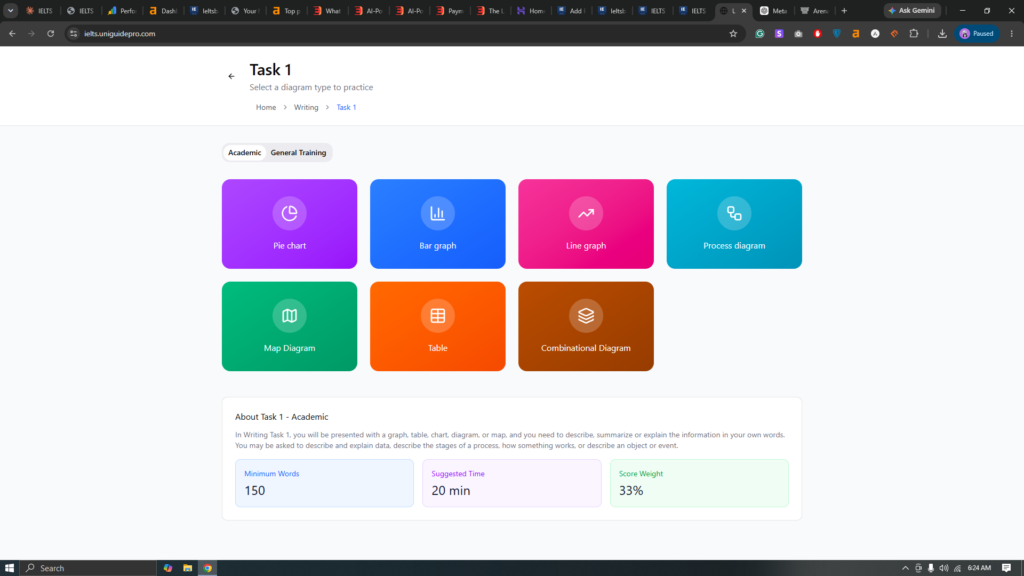
In IELTS Academic Writing Task 1, you are given a visual — this could be:
- A line graph showing trends over time
- A bar chart comparing categories
- A pie chart showing proportions
- A table with data across multiple variables
- A diagram or process showing how something works
- A map showing changes to a location
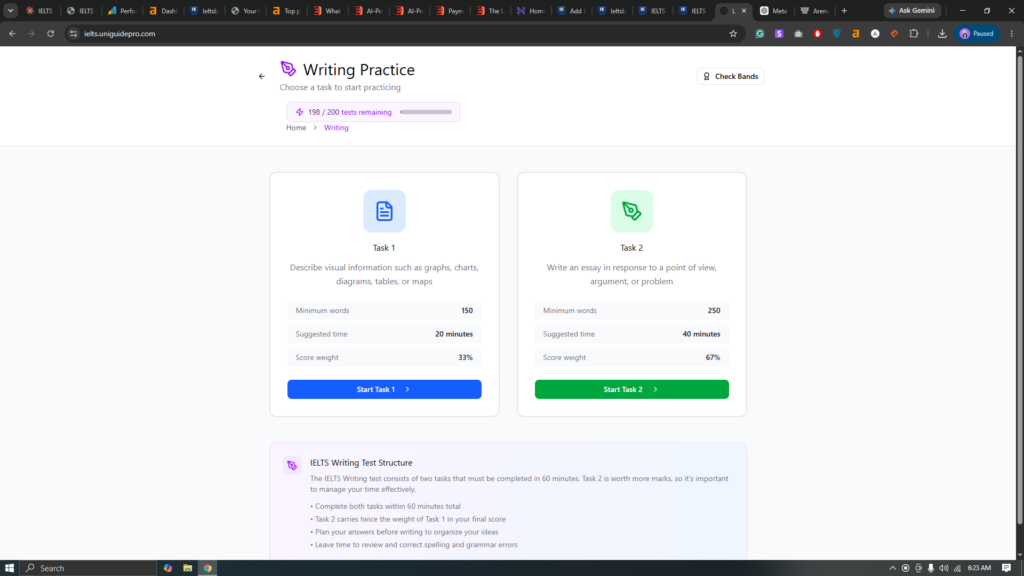
Your job is to write a minimum 150-word report that describes and summarizes the key features of that visual. You have approximately 20 minutes to complete this.
Your report is then scored across four criteria:
| Criterion | What It Measures |
|---|---|
| Task Achievement (TA) | Did you cover the key features accurately? |
| Coherence and Cohesion (CC) | Is your response well-organized and logically connected? |
| Lexical Resource (LR) | Did you use a wide, accurate range of vocabulary? |
| Grammatical Range and Accuracy (GRA) | Did you use varied grammar with minimal errors? |
Each criterion is worth 25% of your Task 1 score. A Report Checker evaluates your writing against all four of these dimensions.
What Does an IELTS Task 1 Report Checker Actually Do?
A quality IELTS Academic Writing Task 1 Report Checker is not just a grammar corrector. It is a comprehensive writing analysis tool that mirrors how a certified IELTS examiner would assess your work.
Here’s what it checks:
1. Task Achievement Analysis
This is where many students quietly lose marks without realizing it.
A report checker will assess:
- Did you write an overview (a summary of the most significant trends)?
- Did you select and highlight key features — not just describe every single data point?
- Did you avoid giving personal opinions or unsupported conclusions?
- Is your report at least 150 words?
Common issue caught: Many students describe data mechanically without ever writing an overview. Without that overview paragraph, your Task Achievement score is automatically capped — usually no higher than Band 5.
2. Coherence and Cohesion Review
A report checker analyzes how well your ideas flow and connect.
It looks for:
- A clear paragraph structure (Introduction → Overview → Body Paragraphs with grouped data)
- Correct use of cohesive devices (“Furthermore,” “In contrast,” “Meanwhile,” “By comparison”)
- Logical sequencing — are you grouping similar data points?
- Appropriate use of referencing (pronouns, synonyms to avoid repetition)
Common issue caught: Students often write one long block of text. A checker flags this instantly. Proper paragraph breaks are not optional — they directly affect your CC score.
3. Lexical Resource Assessment
This criterion rewards vocabulary range, accuracy, and appropriateness.
A Task 1 report checker will identify:
- Overuse of basic words (“increase,” “decrease” repeated throughout)
- Vocabulary errors (e.g., “the data shows a dramatic rise” — incorrect collocation)
- Missed opportunities to use Task 1-specific vocabulary like: surged, plateaued, fluctuated, accounted for, remained stable, witnessed a gradual decline
- Spelling mistakes that signal poor lexical control
Pro tip from ielts.uniguidepro.com: Examiners reward range, not just difficulty. Using “rose sharply” in one sentence and “experienced a significant increase” in another demonstrates better lexical control than repeating the same phrase.
4. Grammatical Range and Accuracy Check
Here’s where most test-takers think their writing is stronger than it actually is.
A report checker evaluates:
- Subject-verb agreement errors
- Incorrect tense usage (e.g., using the present tense for historical data)
- Sentence variety — are you using only simple sentences, or a mix of simple, compound, and complex structures?
- Misuse of articles (“a,” “an,” “the”) — one of the most common error types among non-native speakers
- Passive voice constructions, which are common and appropriate in academic writing
Why You Can’t Rely on Grammar Tools Alone
Tools like Grammarly or Microsoft Word’s grammar checker are useful for surface-level corrections — but they are not IELTS-aware.
They will not tell you:
- That your report is missing an overview
- That you grouped your data poorly
- That your vocabulary, while technically correct, is too basic for a Band 7 response
- That you described irrelevant minor data points instead of focusing on significant trends
An IELTS-specific Task 1 Report Checker — like the one available at ielts.uniguidepro.com — understands the exam’s scoring criteria and gives you feedback in the context of what an actual examiner expects.
The Anatomy of a High-Scoring Task 1 Report
To understand what a checker is looking for, it helps to see what a strong report looks like structurally.
✅ Recommended Structure
Paragraph 1 — Paraphrase the Task Restate what the visual shows in your own words. Never copy the question.
“The line graph illustrates changes in the annual sales figures of three technology companies between 2005 and 2020.”
Paragraph 2 — Overview Summarize the most notable trends or features — without specific data.
“Overall, Company A experienced the most dramatic growth over the period, while Company C showed a consistent decline. Company B’s performance remained comparatively stable throughout.”
Paragraph 3 — Body: First Group of Details. Describe specific data points with figures and dates to support your overview.
Paragraph 4 — Body: Second Group of Details. Continue with contrasting or additional data, using cohesive devices to link ideas.
A report checker reviews whether your report follows this logical flow — and flags where your structure breaks down.
7 Common Task 1 Mistakes a Report Checker Catches
Here are the most frequent errors that cost students marks — and that a good checker will immediately identify:
❌ Mistake 1: No Overview Paragraph
The overview is non-negotiable for a Band 6 or above. Many students skip it entirely.
❌ Mistake 2: Describing Every Data Point
Listing every number from a table or graph doesn’t demonstrate analytical skill — it shows the opposite. Select the most significant trends.
❌ Mistake 3: Giving Reasons or Opinions
Task 1 asks you to describe data, not explain it. Phrases like “This is probably because the economy declined…” are off-task and penalized.
❌ Mistake 4: Using Present Tense for Historical Data
If the graph shows data from the past, use the past tense. If it’s a process diagram, use the present tense. Mixing these is a grammatical error.
❌ Mistake 5: Repetitive Vocabulary
Using “increased” five times in one report signals poor lexical range. A checker flags repetition and suggests alternatives.
❌ Mistake 6: Insufficient Word Count
Responses under 150 words are automatically penalized on Task Achievement. A checker counts your words accurately.
❌ Mistake 7: Poor Paragraph Organization
Starting with body details before the overview, or mixing unrelated data in the same paragraph, damages your Coherence and Cohesion score.
How to Use a Task 1 Report Checker Effectively
Getting feedback is only half the battle. Here’s how to turn checker insights into real improvement:
Step 1: Write Without Assistance First
Before submitting to a checker, write your report independently under timed conditions. This simulates exam conditions and makes the feedback more meaningful.
Step 2: Submit and Review Band Score Estimates
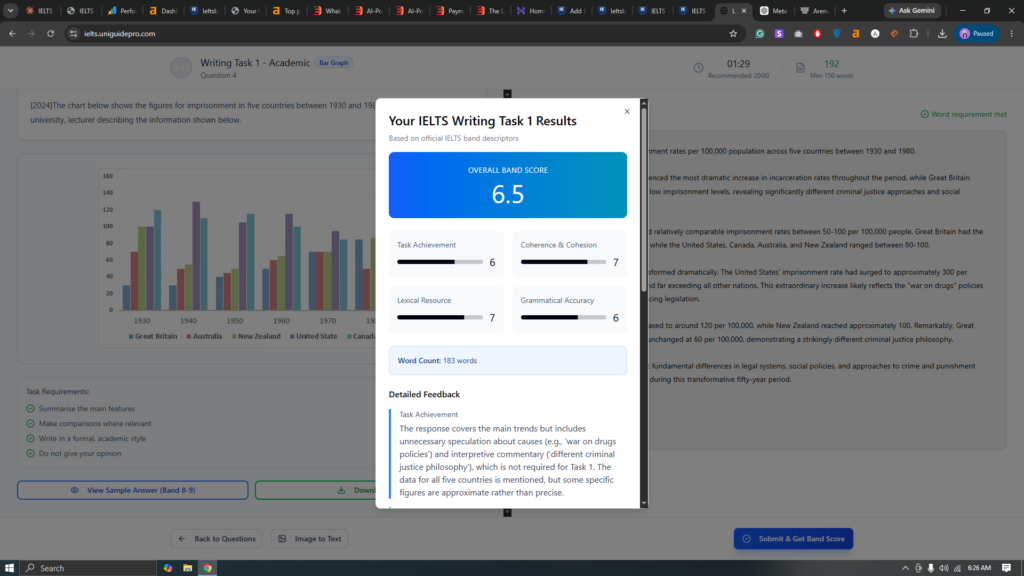
A good checker gives you an estimated band score per criterion, not just an overall mark. Pay attention to which criterion is holding your score back.
Step 3: Prioritize Your Weakest Area
If Task Achievement is your lowest score, work on overview writing and feature selection. If the Lexical Resource is weak, practice vocabulary substitution exercises.
Step 4: Rewrite and Recheck
After making corrections, resubmit. Seeing your score improve confirms that you’ve genuinely understood the feedback — not just edited blindly.
Step 5: Track Patterns Over Multiple Tasks
Use the checker regularly across different Task 1 types (graphs, tables, maps, processes). Patterns in your errors reveal your systematic weaknesses.
Types of IELTS Task 1 Visuals and What Checkers Evaluate
Different visuals demand slightly different approaches. Here’s what a checker evaluates for each:
Line Graphs
- Are you using trend language correctly? (rose, fell, fluctuated, levelled off)
- Did you identify peak and low points with specific data?
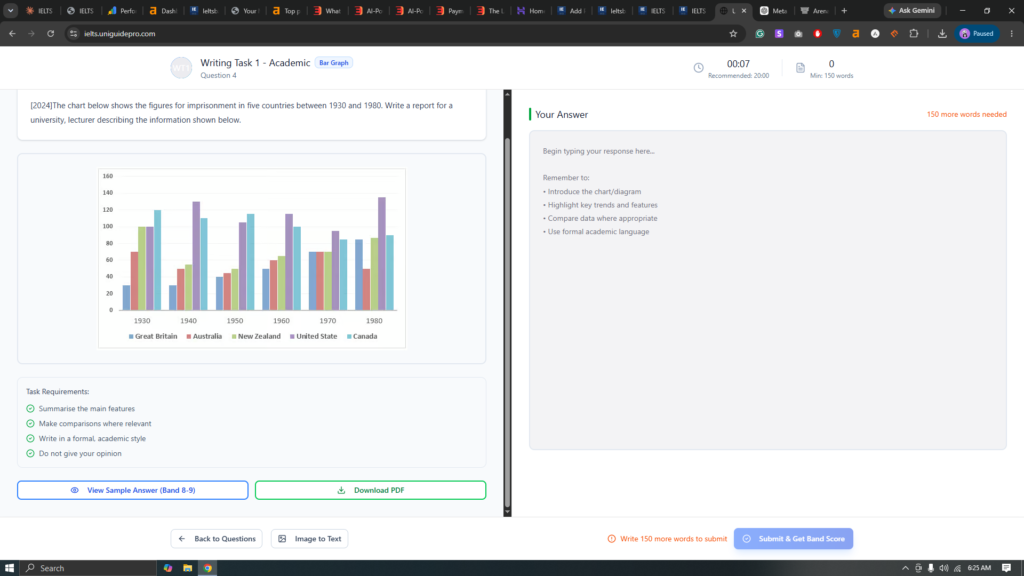
- Are your tenses accurate for the time frame shown?
Bar Charts
- Did you group categories logically rather than describe every bar?
- Are you comparing across categories, not just listing?
Pie Charts
- Are you using proportion language correctly? (accounted for, represented, comprised)
- Did you note the largest and smallest segments clearly in your overview?
Tables
- Did you select the most significant figures rather than listing everything?
- Are your comparisons between rows or columns logical?
Process Diagrams
- Did you use passive voice appropriately? (“The materials are then processed…”)
- Is your response written in the correct tense (present for processes)?
Maps
- Did you describe changes between the two time periods clearly?
- Are you using location language accurately? (to the north of, adjacent to, in the south-eastern corner)
How ielts.uniguidepro.com Supports Your Task 1 Preparation
At ielts.uniguidepro.com, we understand that IELTS success isn’t about luck — it’s about targeted, intelligent preparation.
Our platform is built specifically for IELTS learners who want to understand exactly where their writing stands and exactly what to do to improve it.
Here’s what you get when you use our Task 1 tools:
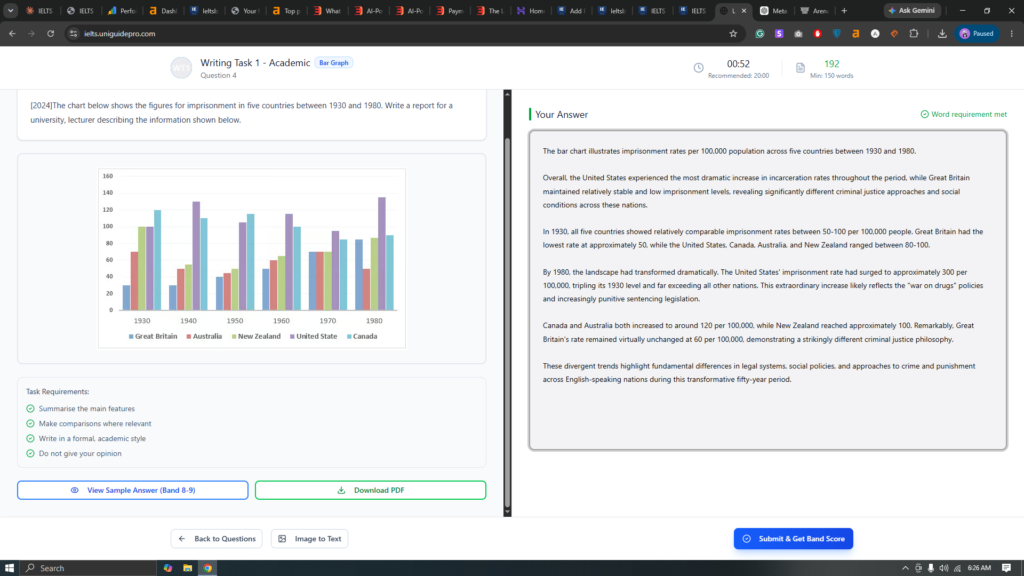
- AI-Powered Report Checker that evaluates all four IELTS scoring criteria
- Band Score Estimates per criterion so you know precisely where to focus
- Vocabulary Enhancement Suggestions tailored to Task 1 language
- Structural Feedback on overview quality and paragraph organization
- Practice Task Library covering all visual types — graphs, tables, maps, and more
- Progress Tracking so you can see your improvement over time
Whether you’re aiming for Band 6.5, Band 7, or Band 8+, ielts.uniguidepro.com gives you the tools and guidance to write with confidence on exam day.
Frequently Asked Questions
Q: Can I use a Task 1 report checker if I’m a beginner? Absolutely. In fact, beginners benefit the most. Getting structured feedback early prevents bad habits from solidifying. Start with simple bar chart tasks and build up from there.
Q: How many Task 1 reports should I write before the exam? Most experienced IELTS tutors recommend writing at least 15–20 Task 1 reports during your preparation, with feedback on each one. Variety matters — cover all visual types.
Q: Does a report checker replace a human tutor? It complements one. A checker gives you instant, consistent, criteria-based feedback at any time. A human tutor can provide nuanced insight into your academic voice and individual style. Using both is the ideal preparation strategy.
Q: What is the most important part of Task 1? The overview. Without a clear, accurate overview, you cannot achieve a Band 6 or above on Task Achievement. It should always be your first priority.
Q: Is 150 words enough for Task 1? It’s the minimum. Most high-scoring responses fall between 170–200 words. Never go under 150, and avoid writing excessively long responses — it wastes time you need for Task 2.
Final Thoughts: Practice Smarter, Not Just Harder
The difference between a Band 5.5 and a Band 7 in IELTS Academic Writing Task 1 is rarely about intelligence or language ability alone. It’s about knowing the criteria, practicing deliberately, and getting the right feedback.
An IELTS Academic Writing Task 1 Report Checker removes the guesswork. It tells you, with precision, where your writing succeeds and where it falls short — against the exact standards your examiner will apply.
Use it consistently. Rewrite with intention. Track your progress.
And when you’re ready to take your IELTS preparation to the next level, ielts.uniguidepro.com is here to guide you — every paragraph of the way.
Start checking your Task 1 reports today at ielts.uniguidepro.com