Everything you need to understand the IELTS Listening test, practice effectively, and boost your band score — for free.
Introduction
The IELTS Listening test is one of the most underestimated sections of the exam. Many candidates assume that if they understand English, they will do well — but the reality is more demanding. You hear each recording only once, you must switch between different English accents, and you need to simultaneously listen, read questions, and write answers — all under timed pressure.
The good news? The Listening section is also one of the most improvable with consistent, targeted practice. A well-structured collection of free online IELTS listening tests is the most efficient way to build the skills, speed, and confidence you need to score higher on test day.
This guide covers everything: the test format, question types, band score calculation, proven strategies, and where to access the best free online IELTS listening test collections — including the comprehensive library available at UniGuide Pro IELTS (ielts.uniguidepro.com).
Understanding the IELTS Listening Test Format
Before diving into practice, you need to know exactly what you are preparing for.
Duration and Structure
The IELTS Listening test lasts 30 minutes, with an additional 10 minutes at the end (for paper-based test takers) to transfer answers to the answer sheet. It consists of four sections and 40 questions in total — 10 questions per section. Each correct answer earns one mark, with no negative marking for wrong answers.
The Four Sections
The four sections increase in difficulty progressively:
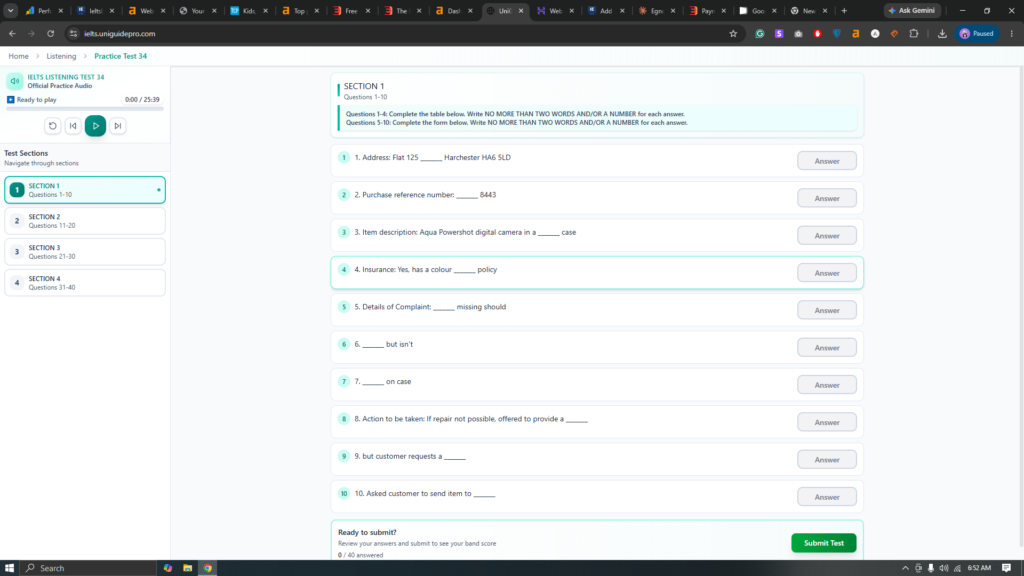
Section 1 — A conversation between two people in an everyday social context, such as booking a hotel room, registering for a course, or inquiring about a service. This is the most accessible section. The speakers talk slowly with clear pauses, and key information is often repeated. Focus on specific facts like names, dates, numbers, and addresses.
Section 2 — A monologue by a single speaker on an everyday topic, such as a radio announcement, a community event description, or information about local facilities. The speaker is slightly faster than in Section 1, but the content remains practical and factual.
Section 3 — A conversation between two to four speakers in an educational or training context, such as students discussing an assignment or a tutor giving feedback. This section introduces more complexity, requiring you to follow multiple voices and track different viewpoints.
Section 4 — A monologue on an academic subject, such as a university lecture on climate change, historical events, or scientific research. This is the most challenging section. The vocabulary is technical, the pace is faster, and speakers rarely repeat themselves. You must grasp both key facts and the speaker’s opinions and attitudes.
Accents You Will Hear
The IELTS Listening test deliberately uses a variety of native English accents — British, Australian, North American, New Zealand, and others. If you have only been exposed to one accent during preparation, switching mid-test can be disorienting. Regular practice with diverse recordings is essential.
Question Types in the IELTS Listening Test
There are several question formats across the four sections. Knowing each type in advance removes the element of surprise and allows you to apply the right strategy immediately.
Multiple Choice — Choose one correct answer (A, B, or C), or sometimes multiple correct answers from a longer list. Tests both specific detail and general understanding.
Form / Note / Table / Flowchart / Summary Completion — Fill in missing words based on what you hear. Always respect the word limit (e.g., “NO MORE THAN TWO WORDS AND/OR A NUMBER”). Answers must match the recording exactly.
Sentence Completion — Complete sentences using words from the recording. Tests your ability to identify specific information within a longer passage.
Short Answer Questions — Answer questions about specific details using words from the recording. Pay close attention to word limits.
Matching — Match a list of items to correct categories or descriptions. Often tests understanding of opinions and attitudes rather than just facts.
Plan / Map / Diagram Labelling — Label a visual using words from the recording. Requires spatial understanding alongside listening comprehension.
How the Band Score Is Calculated
Your raw score out of 40 is converted to a band score on the IELTS 9-point scale (reported in whole and half bands). Here is the approximate conversion:
| Correct Answers (out of 40) | Band Score |
|---|---|
| 39 – 40 | 9.0 |
| 37 – 38 | 8.5 |
| 35 – 36 | 8.0 |
| 32 – 34 | 7.5 |
| 30 – 31 | 7.0 |
| 26 – 29 | 6.5 |
| 23 – 25 | 6.0 |
| 18 – 22 | 5.5 |
| 16 – 17 | 5.0 |
| 13 – 15 | 4.5 |
Note: The exact conversion may vary slightly between test versions. This table serves as a reliable guide for practice purposes.
Why Free Online Listening Tests Are Essential for Preparation
Paid coaching and Cambridge IELTS books are valuable — but a large, freely accessible collection of online listening tests offers specific advantages that are difficult to replicate otherwise.
Volume of practice is the single most important factor in Listening improvement. The more varied recordings you expose yourself to, the more comfortable you become with different accents, speeds, and topics. A free online collection lets you practice daily without budget constraints.
Instant feedback is something physical books cannot provide. Online platforms show you which answers are correct, explain why, and often highlight the exact moment in the audio where the answer appeared. This targeted review accelerates improvement far more than simply checking an answer key.
Realistic test conditions matter. Online tests replicate the actual exam interface — timed sections, audio that plays once only, and question formats that mirror the real test. This reduces test-day anxiety because the format feels familiar.
Flexibility allows you to practice specific sections. If Section 4 (academic monologue) is your weak point, you can target it daily. If map labelling is where you lose marks, you can drill that question type specifically without waiting for it to appear in a full mock test.
Top Strategies to Score Higher on IELTS Listening
Practice alone is not enough — you need to practice with the right technique. These strategies will help you extract maximum value from every listening test you attempt.
1. Read the Questions Before the Audio Starts
You are given 30 seconds to review the questions before each section begins. Use every second of this time. Underline key words in the questions — these are what you are listening for. Knowing what information to expect lets you focus instead of trying to absorb everything.
2. Predict the Type of Answer
Look at the question and predict what kind of word you need — a name, a number, a date, a place, or an adjective. This narrows your focus when listening and prevents you from missing the answer because you were not prepared for its form.
3. Write While You Listen
Do not wait until the audio finishes to write your answer. Write as you go, using abbreviations and shorthand if needed. You can refine your answers during the 10-minute transfer period (paper-based) or review window (computer-based).
4. Watch for Distractors
IELTS Listening deliberately includes information that sounds like the correct answer but is not. Speakers often self-correct (“I mean Tuesday, not Monday”) or mention decoy options before confirming the right one. Always listen to the full context before committing to an answer.
5. Never Leave a Blank
There is no negative marking. If you are unsure, make your best guess. A blank is always wrong; a guess has a chance of being right.
6. Practice with Diverse Accents Daily
Beyond formal practice tests, immerse yourself in English audio from multiple sources — British and Australian podcasts, American news broadcasts, Canadian documentaries. The wider your accent exposure, the less disorienting the real test will feel.
7. Review Every Wrong Answer
After each practice test, spend as much time reviewing your errors as you did taking the test. For every wrong answer, identify whether the error was due to vocabulary, a missed distractor, mishearing, or running out of time. Targeted awareness of your error patterns is what drives score improvement.
What to Look for in a Free Online IELTS Listening Test Collection
Not all free resources are equal. A high-quality free listening test collection should offer:
- Full-length tests that mirror the real exam structure (4 sections, 40 questions, 30 minutes)
- Audio quality that is clear and at realistic exam speed
- Variety of accents across recordings
- All question types represented regularly
- Instant scoring and feedback after submission
- Section-by-section practice for targeted drilling
- Progress tracking so you can monitor improvement over time
- Regular content updates so you are not repeatedly practicing the same tests
UniGuide Pro IELTS: A Free Listening Test Collection Built for Results
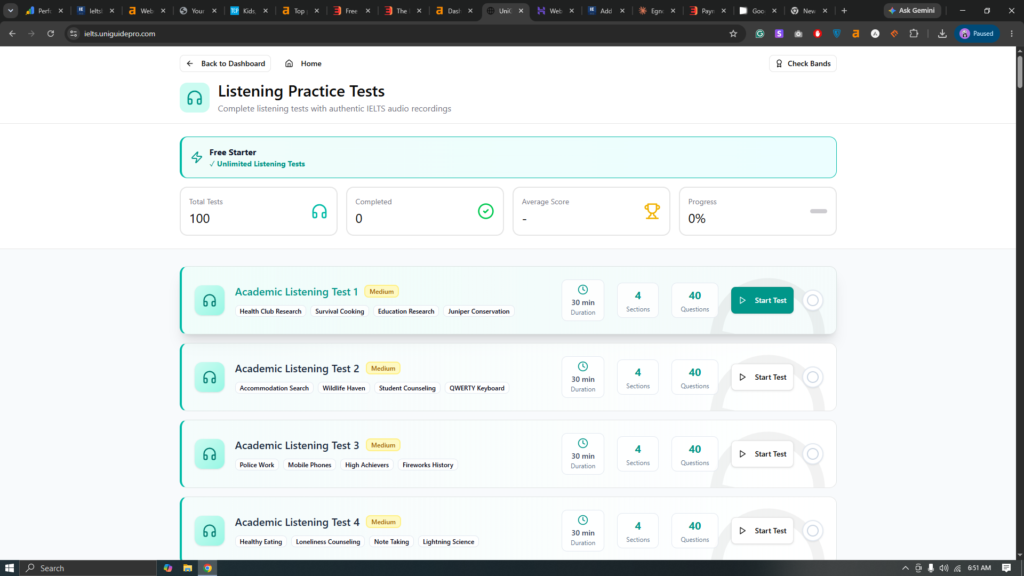
For learners seeking a structured, high-quality free listening practice experience, UniGuide Pro IELTS (ielts.uniguidepro.com) offers one of the most comprehensive and accessible collections available online.
What UniGuide Pro IELTS Offers for Listening Practice
UniGuide Pro IELTS provides a dedicated listening practice module as part of its full four-skill preparation platform. Key features include:
AI-Powered Mock Tests — Full-length IELTS listening mock tests that simulate real exam conditions, including timed audio playback and authentic question formats across all four sections.
Instant Feedback and Scoring — After completing each test, learners receive immediate results with detailed explanations, helping them understand exactly where they went wrong and why.
Progress Tracking with Band Score Prediction — The platform tracks your listening performance over time and updates a predicted band score as you improve. Visual dashboards make progress tangible and motivating.
Personalized Study Plans — After a diagnostic mock test, UniGuide Pro generates a tailored weekly study plan based on your listening weaknesses, telling you which section types and question formats to prioritize.
Free Tier Access — Core listening practice, mock tests, and progress tracking are available at no cost, making them accessible to learners globally regardless of budget.
Premium Upgrade — For learners who want advanced analytics, full writing and speaking integration, and a complete cross-skill preparation experience, the premium tier unlocks the full platform.
A Recommended Free Practice Schedule
Whether you are 8 weeks or 4 weeks away from your exam, consistency is what drives Listening score improvement. Here is a practical free practice framework:
Daily (20–30 minutes): Take one section of a listening test — not always a full test. Focus on the section type where you lose the most marks. Review every wrong answer before moving on.
Twice Weekly: Complete a full 30-minute listening mock test under timed, exam-like conditions. No pausing the audio, no replaying sections. Simulate the real experience as closely as possible.
Weekly: Review your progress tracking dashboard. Identify whether your weak section has improved. Adjust the following week’s practice focus accordingly.
Final Two Weeks Before Exam: Switch to full mock tests only. Prioritize speed, accuracy under pressure, and comfort with the question types and audio pacing.
Common Mistakes to Avoid
Replaying audio during practice — The real test plays each recording exactly once. If you practice with the option to replay, you are preparing for a test that does not exist.
Skipping the review phase — Taking tests without deeply reviewing errors is the most common reason candidates plateau at the same band score for months.
Ignoring spelling — In form completion and sentence completion questions, a correctly heard answer written with a spelling mistake is marked wrong. Practice careful spelling alongside listening.
Practicing only Section 1 — Many learners default to the easiest section because it feels rewarding. Section 4 is where most marks are lost; it needs the most deliberate practice.
Treating listening as passive — Active listening — underlining question keywords, predicting answer types, and writing while you listen — outperforms passive listening every time.
Conclusion
The IELTS Listening test rewards preparation far more than raw English ability. With the right collection of free online practice tests, a clear understanding of the format, and consistent application of the strategies in this guide, meaningful band score improvement is within reach for any candidate.
Platforms like UniGuide Pro IELTS (ielts.uniguidepro.com) make high-quality listening practice accessible to everyone — with AI-powered mock tests, instant feedback, progress tracking, and personalized study plans available free of charge. There is no reason to walk into the exam hall unprepared when a world-class practice collection is just a click away.
Start with a diagnostic listening test today, identify your weak sections, and build from there. Every practice session is one step closer to your target band score.
The IELTS Listening test is the same for both IELTS Academic and IELTS General Training. All practice resources referenced in this article are suitable for both test formats.